
ICH M7 Assessment
Practical FAQs
Lhasa Limited has occupied the ICH M7 mutagenic impurities space since its publication in July 2014, anticipating the market’s needs by launching Sarah Nexus (Lhasa Limited) while ICH M7 was still at a proposed stage in 2013.
Understanding an ICH M7 assessment is only half the job; performing it is the other. Our members’ biggest challenge is deciding what to do when a prediction falls out of domain, two (Q)SAR methods disagree, or a purge ratio falls short of your required margin
This page answers those questions in the order you meet them in an assessment, from choosing which impurities to assess through to justifying your control strategy. Every question comes from the toxicologists and chemists Lhasa guides.
Our global ICH M7 community sets us apart. We believe decisions shouldn’t be made alone.
New to the guideline? Start with our ICH M7 knowledge base and FAQs, which explain what ICH M7 requires.
Every question on this page originates from conversations with Lhasa Limited members. Lhasa scientists wrote the answers, and our application scientists reviewed them against ICH M7(R2). Last reviewed .
Compiled by Emily Hatfield and Lara James, Senior Marketing and Communications Partners.
Reviewed by Kristina Hetherington and Dr Maria Celeste del Fueyo, Senior Application Scientists, and Hannah Kitchingman and Lucía Toscano Bayona, Application Scientists.
Find out what to do next in your ICH M7 assessment
Setting up the assessment
What do I do if the drug substance has no mutagenicity data?
You can still assess and classify the impurity, but you can't use the drug substance to justify Class 4. Class 4 needs the shared alert to have been tested and found negative in the Ames test, either in the drug substance itself or in a related compound. Without sufficient negative data (an Ames test conducted in accordance with OECD Test Guideline 471), you have three options:
First, look for a related compound that has been tested, such as a process intermediate carrying the same alert in the same position and chemical environment. Second, test the impurity in an Ames test: a negative result leads to a Class 5 classification and a positive result to Class 2. Third, treat it as Class 3 and control it at the TTC-based limit.
Before you conclude there are no data, check the drug substance's own nonclinical package. By later development, most drug substances have been through standard genotoxicity testing, which normally includes an Ames test.
Sources: ICH M7(R2) guideline (2023).
How do I decide which impurities to assess, and what if the theoretical list runs to hundreds?
Assess actual impurities and those potential impurities that are likely to arise. That doesn't mean every structure a reaction scheme could theoretically produce.
For synthetic impurities, start with starting materials, reagents, intermediates and reasonably expected by-products from the starting material onwards. Include known impurities of the starting materials, which may be listed in the supplier's specification depending on how the material is sourced. You can give a risk-based justification for the point in the route after which impurities need evaluating, because impurities from early steps of long routes often have negligible risk of carrying through. A purge argument can support that justification and keep the list manageable, particularly for impurities introduced early in the route (see purge ratios below 1,000). Published risk assessment strategies include examples of this approach. If a starting material is introduced late, look at the final steps of its own synthesis. For degradation products, use degradation chemistry, stress testing and development stability data to focus on the pathways that are relevant under long-term storage.
Expect the list to grow through development. Fewer impurities are identified early on, and the number assessed is expected to increase by the marketing application. Rank what's left by how likely each impurity is to form and carry through, and record why you excluded the rest.
Sources: ICH M7(R2) guideline (2023); Teasdale et al. (2013), Organic Process Research & Development 17:221–230.
My chemistry suggests an impurity could form, but it hasn't been predicted or detected. Do I need to assess it?
Yes. If an impurity hasn't been predicted or detected, that isn't evidence it won't form. ICH M7 asks you to assess by-products and degradation products that are reasonably expected from the chemistry, so your own chemical judgement counts. If the chemistry makes the impurity plausible, add it as a potential impurity, assess its mutagenic potential, and then decide how to deal with it.
There are two ways to settle it. One is a fate-and-purge argument showing the impurity would be removed well below the acceptable limit. The other is analytical data, either demonstrating the impurity is absent at a suitable limit of detection or measuring how much is there. For a suspected degradation product, an accelerated stability study in the proposed packaging is the recommended way to show whether the pathway is relevant. In early clinical development, chemistry arguments can be enough for impurities with a low likelihood of being present.
Sources: ICH M7(R2) guideline (2023).
How should I prepare salts, stereoisomers, tautomers and charged species for (Q)SAR prediction?
Start by assessing the structure as it is, including the salt form. Experimental data, sometimes including an Ames result, may already exist for the salt itself, which can settle the question directly. If the salt can't be assessed as a whole, for example a metal complex that returns an out-of-domain result, separate the components. Assess the organic ligand or parent molecule for mutagenic potential under ICH M7, and the metal under ICH Q3D.
Don't assume every salt can be split. Some have interactions closer to a covalent bond than an ionic one, so judge the bonding before separating the components. Some combinations of counter-ion and process conditions also create well-known risks, such as sulfonate esters forming from sulfonic acids and alcohols, and these need their own assessment.
Stereochemistry rarely changes whether a structure is mutagenic, but include it where it matters for the reactivity of an alerting group. Many expert systems take common tautomeric forms into account automatically. Check which forms were assessed, and consider any other tautomer that is relevant under physiological conditions, because an alert may only appear in one form. For charged species, think about the neutral or reactive form that could form in the body.
Whether ICH M7 applies to your product at all (peptides, biologics, very large molecules) is a scope question, covered in our ICH M7 FAQs.
Sources: ICH M7(R2) guideline (2023); Amberg et al. (2016), Regulatory Toxicology and Pharmacology 77:13–24.
Interpreting predictions
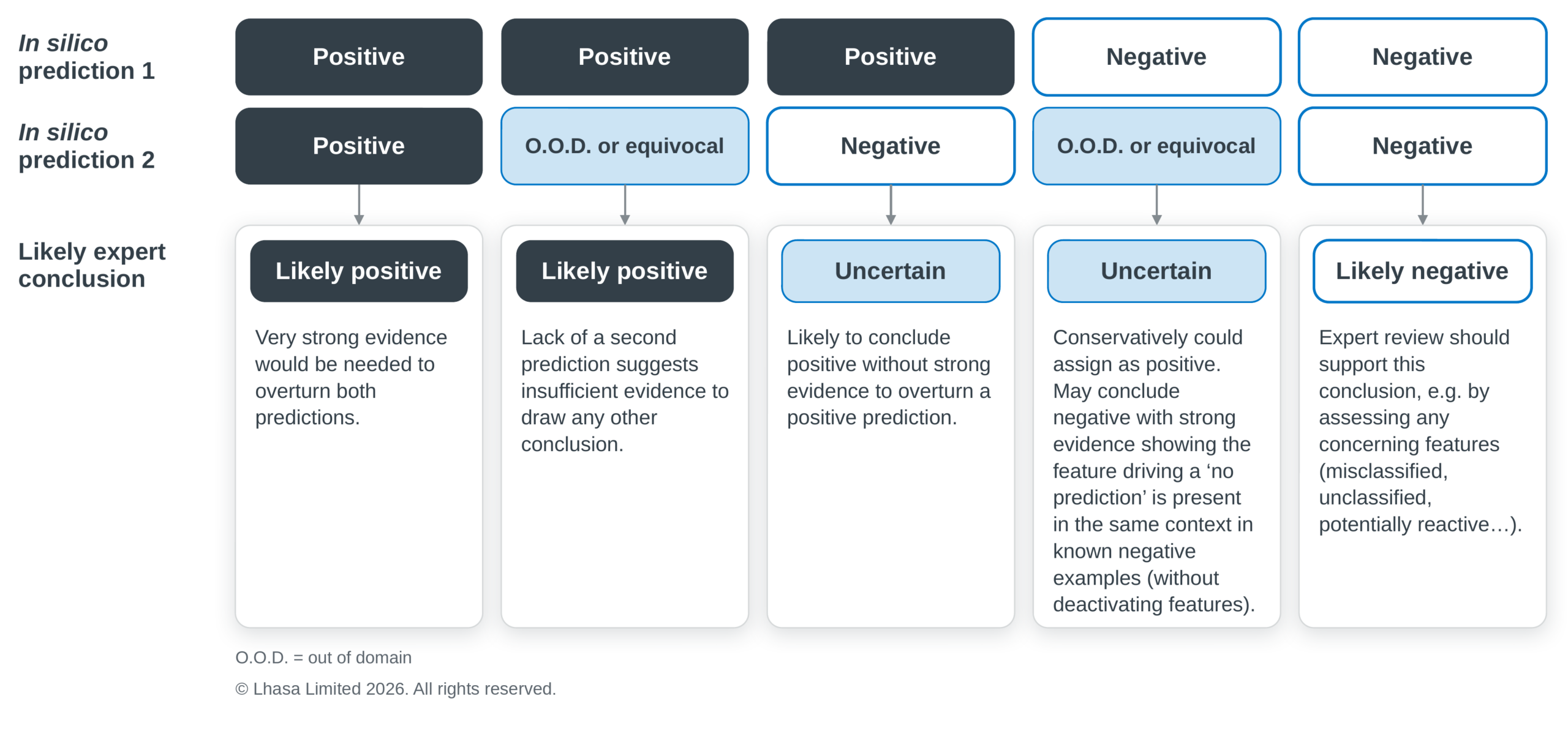
My two (Q)SAR methods give conflicting predictions. What do I do?
Expect this to happen sometimes. Neither system's prediction takes priority over the other. The goal of your review is to establish whether the risk flagged by the positive prediction can be mitigated. The two methodologies are deliberately different, and ICH M7 provides for expert knowledge to resolve conflicting predictions and give a rationale for the final conclusion. Don't simply pick the answer you prefer. Work through the evidence behind each prediction:
First, look at the mechanism by which the impurity is predicted to be positive. Is the alerting group actually present and able to react, or is it deactivated by the surrounding structure? Second, look at analogues, using a read-across-style comparison. Are there closely related compounds with reliable Ames data, and do they support one prediction over the other? Third, look at data quality. Are the underlying Ames results complete, consistent and from appropriate studies?
Record one overall conclusion and your reasons. If the risk can't be mitigated, take a conservative approach: classify the impurity as Class 3. You can then either control it at the TTC-based limit or run an Ames test, and the Ames result will overrule both predictions.
Sources: ICH M7(R2) guideline (2023); ICH M7(R2) Questions and Answers (2022, corrected 2023); Barber et al. (2015), Regulatory Toxicology and Pharmacology 73:367–377; Amberg et al. (2016), Regulatory Toxicology and Pharmacology 77:13–24; Foster et al. (2020), Genes and Environment.
Worked example: an aromatic amine alerts in one method but is negative in the other. How do I resolve it?
This is a common case of the conflicting predictions described above. Aromatic amines are a well-known alerting class, but whether a particular one is mutagenic depends heavily on its stereoelectronic properties and substitution pattern. Aromatic amines must undergo metabolic activation to become mutagenic, so features that affect that reaction, and the stability of the resulting reactive species, can switch activity on or off. A negative statistical prediction may reflect tested analogues that share a deactivating pattern. It may also rest on analogues that aren't truly comparable.
Check whether the negative analogues really share your substitution pattern. Check whether any known deactivating features apply to your compound. Check the quality of the test data: purity matters a great deal for this class, because trace mutagenic contaminants can drive a positive result. The ICH M7 Q&A singles out an aromatic amine with a negative prediction as a case where reassessment is recommended. If the risk can't be mitigated, treat the impurity as Class 3 or test it.
Sources: ICH M7(R2) guideline (2023); ICH M7(R2) Questions and Answers (2022, corrected 2023); Foster et al. (2020), Genes and Environment.
My prediction is out of domain. What do I do next?
An out-of-domain or no-coverage result means a model doesn't have enough relevant data to predict with confidence. It isn't a negative result. The ICH M7 Q&A is explicit: if one of your two models gives an out-of-domain result, you can't classify the impurity as Class 5 without additional assessment.
The ICH M7 Q&A describes three accepted routes, which can be used alone or together. First, read-across. Start by checking whether the out-of-domain feature is also present in the drug substance or a tested related compound, in the same chemical environment. If that compound is Ames-negative, it gives direct support (see using analogues). Otherwise, compare the impurity with structurally similar analogues that have Ames data. Second, review the structure yourself to judge whether it has the potential to react with DNA. Third, run an additional validated model of the same methodology that does place the compound within its domain.
The relationship between structure and DNA reactivity is well understood, so a mutagenic structure is unlikely to be out of domain. That is why these routes usually give reassurance rather than raise a new concern.
Sources: ICH M7(R2) Questions and Answers (2022, corrected 2023); Barber et al. (2015), Regulatory Toxicology and Pharmacology 73:367–377; Amberg et al. (2019), Regulatory Toxicology and Pharmacology 102:53–64.
Can I use an analogue — such as a hydrolysis product or the drug substance — to resolve an out-of-domain prediction?
Yes. Read-across to analogues with Ames data is one of the routes the ICH M7 Q&A accepts. It only works if the analogue contains the feature that is causing the uncertainty, in a comparable chemical environment, and has reliable Ames data. A hydrolysis product or a fragment can help if it keeps that feature. It doesn't help if the feature is lost.
The drug substance can serve as the analogue only if it contains the same feature in the same position and chemical environment and has tested negative in the Ames test. That is the same logic as Class 4. If the drug substance doesn't contain the uncertain feature, its Ames result tells you nothing about it. Whatever analogue you use, explain why it is relevant: which features are shared, which differ, and why the differences don't matter.
Sources: ICH M7(R2) guideline (2023); ICH M7(R2) Questions and Answers (2022, corrected 2023); Amberg et al. (2019), Regulatory Toxicology and Pharmacology 102:53–64.
Neither of my (Q)SAR methods flagged an alert. Is there still a mutagenic concern?
Usually not, provided both methods are in domain and the negative predictions are well supported. ICH M7 treats the absence of structural alerts from two complementary methods, one expert rule-based and one statistical, as sufficient to conclude that the impurity has no mutagenic concern (Class 5), with no further testing recommended. No alert from one system on its own isn't enough. Nor is a visual check for alerts. And if one model is out of domain, you need additional assessment first.
Look at how well supported each negative is. A negative prediction from an expert rule-based system is most reliable when it is based on more than the absence of an alert, for example when the compound's features have been checked against a large set of compounds with Ames data. Any features that aren't represented in that data are worth a short review. A negative from a statistical model depends on the quality of the model and on how relevant its similar training compounds are. If you have a specific reason to doubt a negative, such as an aromatic amine predicted negative, the ICH M7 Q&A recommends reassessing it.
Sources: ICH M7(R2) guideline (2023); ICH M7(R2) Questions and Answers (2022, corrected 2023); Williams et al. (2016), Regulatory Toxicology and Pharmacology 76:79–86.
Expert review
How detailed does my expert review need to be, and is there a checklist?
ICH M7 doesn't set a length or format. What it does expect, in a marketing application, is each impurity's classification with the rationale behind it. That includes the (Q)SAR systems used, their results, and the supporting information behind any Class 4 or Class 5 conclusion.
The ICH M7 Q&A recommends a summary table to make this clear. For each impurity, include:
- The structure
- Each (Q)SAR result, including any out-of-domain calls
- Any Ames results
- The assigned class
- Supporting information such as literature, analogue data or your expert analysis
You can also note the name, version and endpoint of the in silico systems used.
Match the depth to the difficulty. Two agreeing predictions may need only a brief confirmation. Conflicting, out-of-domain or borderline results need a full, reasoned argument. A practical test is whether another expert reading your review for the first time would reach the same conclusion. Published industry principles offer a structure to follow.
Sources: ICH M7(R2) guideline (2023); ICH M7(R2) Questions and Answers (2022, corrected 2023); Barber et al. (2015), Regulatory Toxicology and Pharmacology 73:367–377; Amberg et al. (2016), Regulatory Toxicology and Pharmacology 77:13–24; Foster et al. (2020), Genes and Environment.
Both (Q)SAR methods predict negative. Do I still need expert review or an Ames test?
No Ames test is needed. ICH M7 treats the absence of alerts from two complementary methods as enough to classify the impurity as Class 5. The ICH M7 Q&A confirms that no further genotoxicity testing is warranted for impurities present at up to 1 mg per day. Above 1 mg per day in chronic use, a minimum genotoxicity screen (a point mutation test and a chromosomal aberration test) could be considered.
Expert review isn't mandatory here, but assessors commonly expect a brief check, and it is good practice. Confirm that neither result is out of domain, that the whole molecule has been assessed by both systems, that any flagged features have been reviewed, and that the negatives are based on relevant data. If predictions were made early in development, the ICH M7 Q&A recommends re-running them before the initial marketing application, because models are updated with new data.
Sources: ICH M7(R2) guideline (2023); ICH M7(R2) Questions and Answers (2022, corrected 2023).
I'm assessing a batch of impurities. How much review does each one need?
Each impurity needs its own classification and rationale, but the effort can be proportionate. Clear negatives from both methods need only a brief confirmation. Spend most of your time on impurities with alerts, conflicting predictions, out-of-domain results or uncertain data. The ICH M7 Q&A's recommended summary table is a practical way to document a batch consistently.
What you document also depends on the stage of development. For Phase 1 trials of 14 days or less, the focus is on Class 1 and Class 2 impurities and the cohort of concern. Class 3 impurities are added for longer Phase 1 and Phase 2a trials. By Phase 2b and Phase 3, a full list of impurities assessed by (Q)SAR is expected.
Sources: ICH M7(R2) guideline (2023); ICH M7(R2) Questions and Answers (2022, corrected 2023).
Classification
My impurity shares a structural alert with a non-mutagenic drug substance. Can I classify it as Class 4?
Often, yes. ICH M7 allows Class 4 when the impurity's structural alert is shared with the drug substance or a related compound, meaning the same alert in the same position and chemical environment, and that material has tested negative in the Ames test. The reasoning is that the impurity poses no more concern than a compound already shown to be non-mutagenic.
Check three things before relying on it. First, that the alert really is in an equivalent chemical environment in both structures, and that nearby differences don't change its reactivity. Second, that the impurity has no additional alerts that the drug substance lacks. Third, that there are no impurity-specific data, such as a positive Ames result or carcinogenicity data, which would take priority. Record the comparison explicitly, because it is the supporting information regulators expect for a Class 4 conclusion.
Sources: ICH M7(R2) guideline (2023).
What evidence do I need to move an impurity from Class 3 to Class 5?
The standard route is an appropriately conducted Ames test on the impurity itself. A negative result overrules any structure-based concern, the impurity becomes Class 5, and ICH M7 recommends no further genotoxicity assessment. That conclusion is limited to ICH M7's scope. The Ames test only detects mutagenicity, so it says nothing about clastogenicity or non-genotoxic routes to cancer, which are assessed under other guidance (see our ICH M7 FAQs).
ICH M7 allows some flexibility in how the Ames test is done. It should normally follow OECD 471 and ICH S2(R1), ideally under GLP. Deviations don't automatically invalidate the data, but they should be described. The tester strains can be limited to those shown to be sensitive to the alert. Where not enough of the impurity is available, a miniaturised assay with proven high agreement with the standard test can be used, with justification.
Class 5 also covers an alerting structure with enough other data to show it isn't mutagenic, so a well-supported analogue argument can sometimes work. It needs careful documentation. Other genotoxicity data can also be informative as part of the weight of evidence, for example where the impurity's carcinogenicity data are conflicting or unreliable. Class 1 is different: it is based on existing Ames and carcinogenicity data and can't be argued down.
Sources: ICH M7(R2) guideline (2023); ICH M7(R2) Questions and Answers (2022, corrected 2023).
A pharmacopoeial (monograph-listed) impurity predicts as Class 2 or 3. What now?
First, work out whether ICH M7 applies to your submission. It isn't applied retrospectively to products already on the market. It applies to new drug substances and products, and to post-approval changes that introduce new impurities, raise acceptance criteria, or significantly change the dose or indication. A product approved in one region and filed for the first time in another counts as new.
Where ICH M7 does apply, being listed in a monograph doesn't change an impurity's classification. A Class 2 or Class 3 impurity needs to be controlled at its ICH M7 acceptable limit. That limit may be stricter than the monograph limit, unless experimental data such as a negative Ames test support Class 5.
Sources: ICH M7(R2) guideline (2023).
Setting acceptable intakes
My impurity looks like Class 1, but I can't find a TD50. How do I proceed?
Check the classification first. Class 1 means the impurity is a known mutagenic carcinogen, with positive mutagenicity and carcinogenicity data. Without carcinogenicity data, a known mutagen is Class 2. It is controlled at the TTC-based limit, unless it belongs to the cohort of concern, adjusted for treatment duration where appropriate.
If carcinogenicity data exist but no TD50 has been published, an acceptable intake can be derived from the dose–response data, by linear extrapolation or a benchmark dose. Check the ICH M7 Addendum and values published by international bodies before you calculate your own. If the impurity is structurally similar to a well-characterised class of carcinogens, a class-specific AI may be justified with supporting data. Monofunctional alkyl chlorides are an example where ICH M7 supports a limit higher than the TTC.
LD50 values aren't appropriate for setting limits on mutagenic impurities. A PDE can be used only where there is evidence of a practical threshold, meaning a dose response that is non-linear or has a threshold. The Addendum includes threshold-based PDEs for a small number of compounds, such as aniline. If a Class 2 impurity can't be controlled to the TTC, an appropriate in vivo mutation study can support a higher limit case by case, as part of a weight-of-evidence argument.
Sources: ICH M7(R2) guideline (2023); ICH M7(R2) Addendum (2023); ICH M7(R2) Questions and Answers (2022, corrected 2023).
How do I apply a less-than-lifetime limit for my treatment duration?
First, decide which duration category fits most patients. The ICH M7 examples help here. HIV treatment, for instance, moved to the more-than-10-years category in the R2 revision. For intermittent dosing, count the actual dosing days, not the calendar period.
Second, apply the limit for a single impurity: up to 1 month, 120 µg/day; more than 1 month and up to 12 months, 20 µg/day; more than 1 year and up to 10 years, 10 µg/day; more than 10 years, 1.5 µg/day. If three or more Class 2 or Class 3 impurities are specified on the drug substance specification, also apply the total limits of 120, 60, 30 and 5 µg/day.
Third, for compound-specific AIs, scale in the same proportions or cap at 0.5% of the daily dose, whichever is lower. Don't apply the LTL approach to PDEs. For nitrosamines, follow regional guidance. Since 24 September 2026, the FDA has accepted LTL adjustment factors for recommended (not interim) nitrosamine AIs: 80 times the lifetime AI for up to 1 month, 13.3 times for more than 1 month and up to 12 months, and 6.67 times for more than 1 year and up to 10 years. For Phase 1 trials of up to 14 days, an alternative approach limits control to Class 1, Class 2 and cohort-of-concern impurities.
Sources: ICH M7(R2) guideline (2023); ICH M7(R2) Questions and Answers (2022, corrected 2023); Felter et al. (2025), Regulatory Toxicology and Pharmacology 162:105903; Felter et al. (2026), Regulatory Toxicology and Pharmacology 106245; FDA, Application of less-than-lifetime adjustment to nitrosamine impurities (24 September 2026).
Control strategy and purge
My purge ratio is below 1,000. What supporting data do I need?
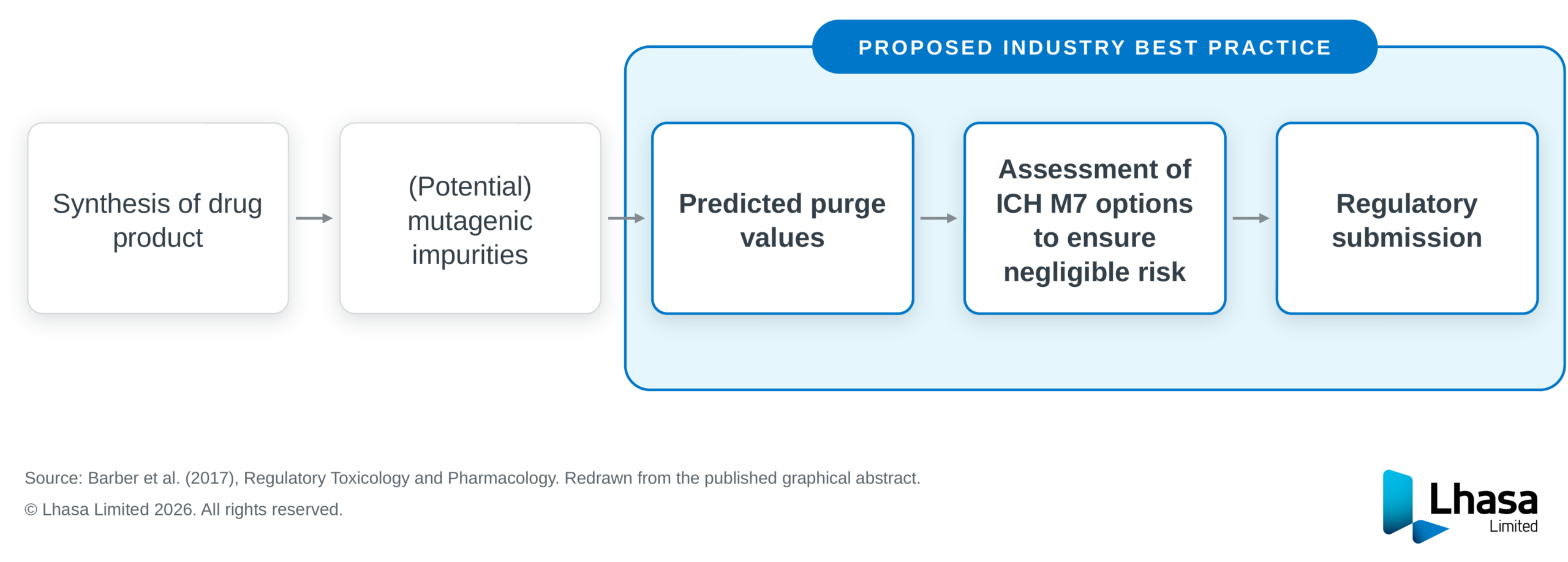
Start from the regulatory criterion in the ICH M7 Q&A. If your predicted purge puts the impurity below 1% of the TTC or AI, the risk can be considered negligible, which supports Option 4. If the prediction puts it above 1%, you need measured purge data, typically spike-and-purge experiments under conditions relevant to your process, showing levels below 10% of the limit. Laboratory-scale spiking studies are normally sufficient. You don't need to spike at pilot or commercial scale, but consider whether scale could affect purge.
An industry consortium framework maps the ratio of predicted to required purge onto the evidence to provide. A large margin can be justified by calculation. Smaller margins need literature support and analytical data, moving towards trace-level measurements as the margin narrows. The closer the predicted level is to the limit, the more detail you need to provide on the calculation.
If Option 4 can't be justified, Option 3 is the fallback: an upstream test backed by fate-and-purge knowledge showing the drug substance level will be below 30% of the limit. Failing that, use Option 1 or 2. For impurities introduced in the last step, prediction alone is rarely enough. Nitrosamines are assessed case by case.
Sources: ICH M7(R2) guideline (2023); ICH M7(R2) Questions and Answers (2022, corrected 2023); Barber et al. (2017), Regulatory Toxicology and Pharmacology 90:22–28.
These answers give general guidance on applying ICH M7. They were checked against ICH M7(R2), its Addendum and its Questions and Answers, and reviewed by Lhasa Limited application scientists in October 2026. Regional guidance, particularly on nitrosamines, changes often, so check the current position of the agency you are submitting to.
Cite & reference Lhasa ICH M7 science
Cite this image in your research
Barber C, Amberg A, Custer L, Dobo KL, Glowienke S, Van Gompel J, Gutsell S, Harvey J, Honma M, Kenyon MO, Kruhlak N, Muster W, Stavitskaya L, Teasdale A, Vessey J, Wichard J (2015). Establishing best practise in the application of expert review of mutagenicity under ICH M7. Regulatory Toxicology and Pharmacology 73(1):367–377.
Figure adapted from Barber et al. (2015). © Lhasa Limited.
Cite this image in your research
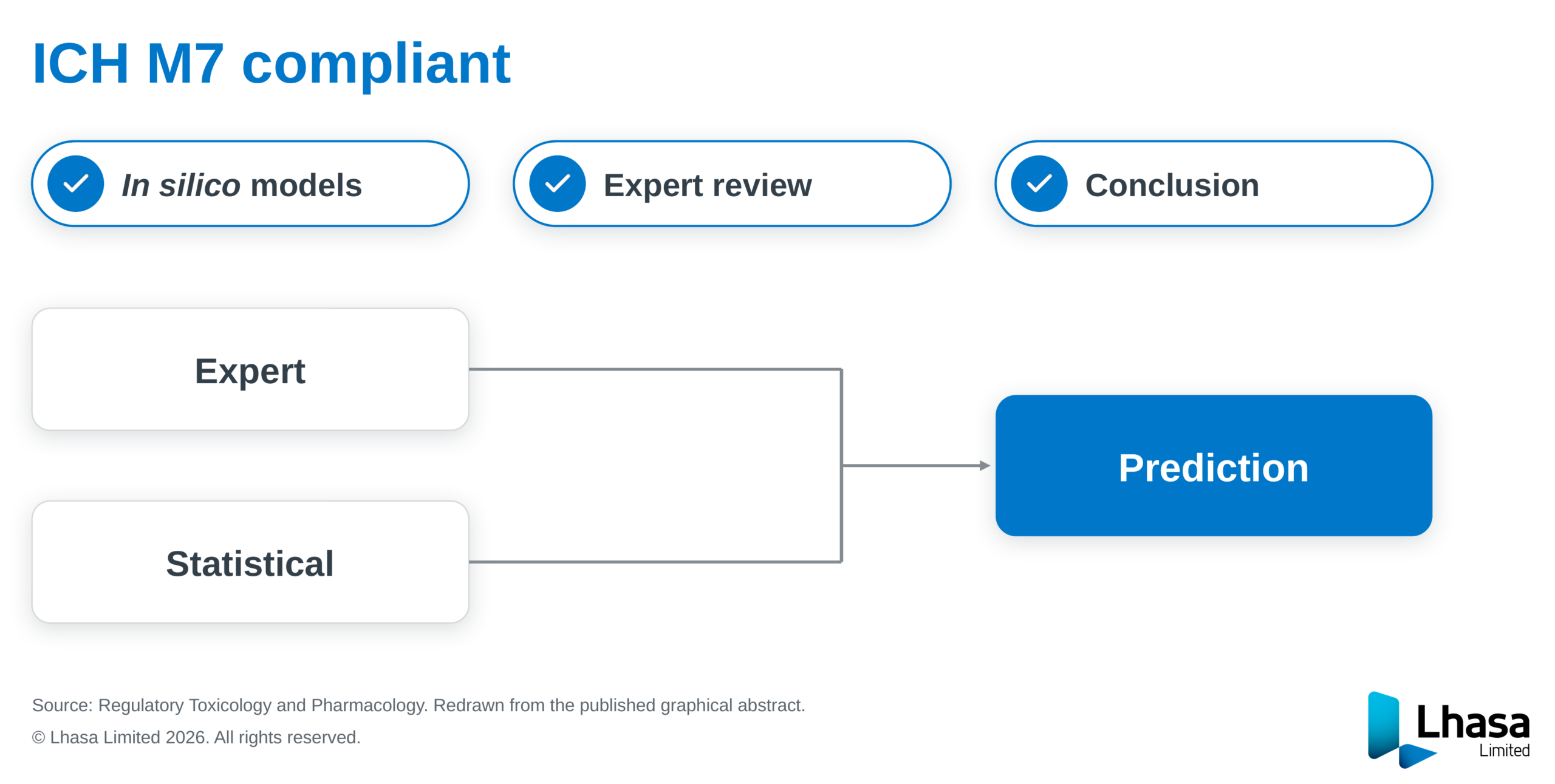
Barber C, Hanser T, Judson P, Williams R (2017). Distinguishing between expert and statistical systems for application under ICH M7. Regulatory Toxicology and Pharmacology 84:124–130.
Figure adapted from Barber et al. (2017). © Lhasa Limited.
Distinguishing between expert and statistical systems for application under ICH M7
Cite this image in your research
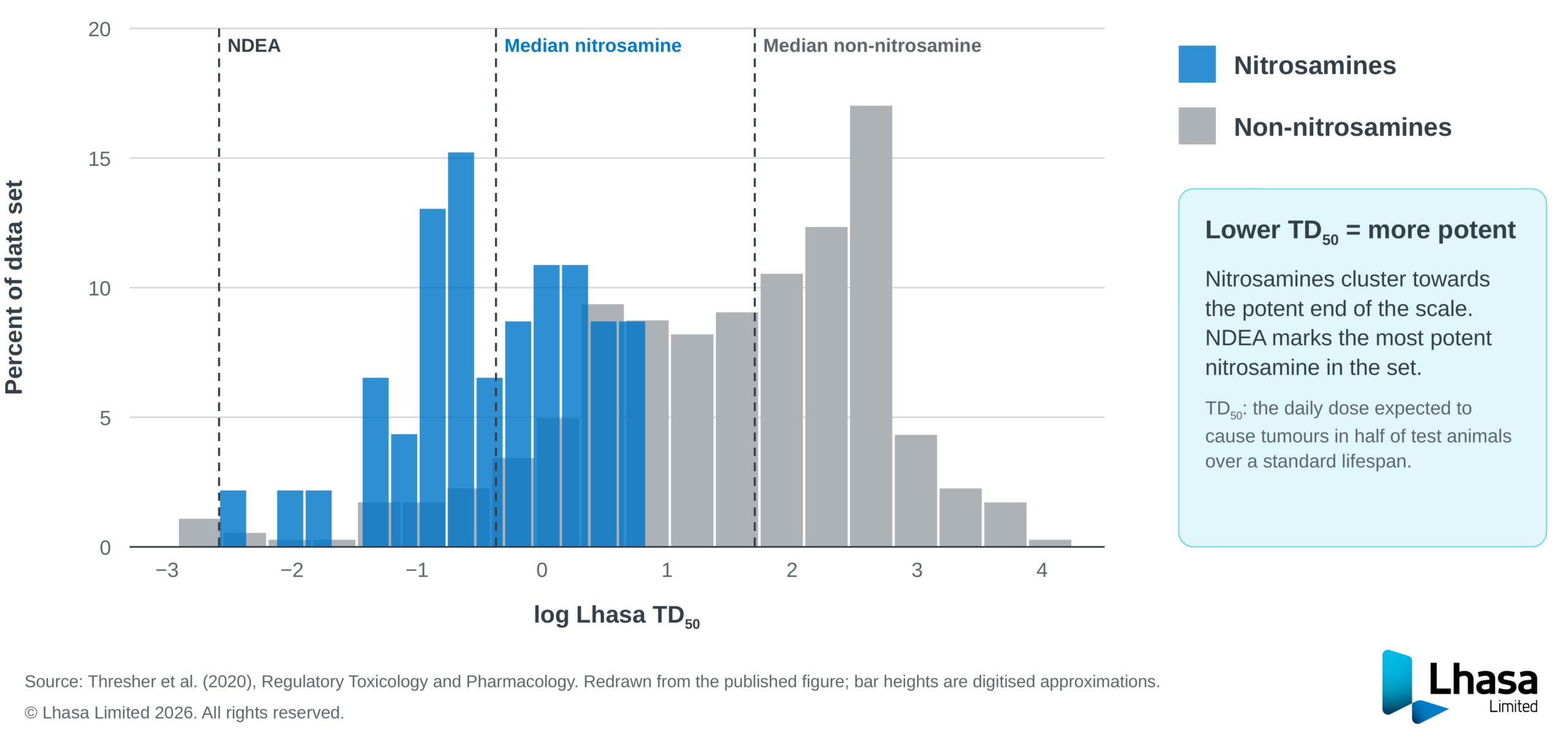
Thresher A, Foster RS, Ponting DJ, Stalford SA, Tennant RE, Thomas R (2020). Are all nitrosamines concerning? A review of mutagenicity and carcinogenicity data. Regulatory Toxicology and Pharmacology 116:104749.
Figure adapted from Thresher et al. (2020). © Lhasa Limited.
Cite this image in your research
Barber C, Antonucci V, et al. (2017). A consortium-driven framework to guide the implementation of ICH M7 Option 4 control strategies. Regulatory Toxicology and Pharmacology 90:22–28.
Figure adapted from Barber et al. (2017). © Lhasa Limited.
Regulatory support
ICH M7
ICH M7 recommends two complementary (Q)SAR methodologies: one expert rule-based and one statistical. Lhasa Limited provides both. Derek Nexus (Lhasa Limited) gives the expert rule-based prediction, and Sarah Nexus gives the statistical prediction. Used together, they meet the ICH M7 recommendation and support a full impurity classification.
References
- ICH (2023). M7(R2): Assessment and control of DNA reactive (mutagenic) impurities in pharmaceuticals to limit potential carcinogenic risk. Adopted 3 April 2023. View source
- ICH (2023). Addendum to M7(R2): Application of the principles of the ICH M7 guideline to calculation of compound-specific acceptable intakes. Adopted 3 April 2023. View source
- ICH (2022). M7(R2) Questions and Answers. Adopted 24 May 2022; error correction issued 24 May 2023. View source
- Barber C, Amberg A, Custer L, et al. (2015). Establishing best practise in the application of expert review of mutagenicity under ICH M7. Regul Toxicol Pharmacol 73:367–377. View source
- Amberg A, et al. (2016). Principles and procedures for implementation of ICH M7 recommended (Q)SAR analyses. Regul Toxicol Pharmacol 77:13–24.
- Amberg A, et al. (2019). Principles and procedures for handling out-of-domain and indeterminate results as part of ICH M7 recommended (Q)SAR analyses. Regul Toxicol Pharmacol 102:53–64. View source
- Foster RS, et al. (2020). The importance of expert review to clarify ambiguous situations for (Q)SAR predictions under ICH M7. Genes and Environment. View source
- Williams RV, et al. (2016). It’s difficult, but important, to make negative predictions. Regul Toxicol Pharmacol 76:79–86. View source
- Barber C, et al. (2017). A consortium-driven framework to guide the implementation of ICH M7 Option 4 control strategies. Regul Toxicol Pharmacol 90:22–28. View source
- Teasdale A, et al. (2013). Risk assessment of genotoxic impurities in new chemical entities: strategies to demonstrate control. Org Process Res Dev 17:221–230.
- Felter SP, Mudd AM, Ponting DJ, Thomas R, et al. (2025). Evaluating the lifetime cumulative dose as a basis for carcinogenic potency of nitrosamines. Regul Toxicol Pharmacol 162:105903. View source
- Felter SP, Bercu JP, Jolly RA, et al. (2026). Applicability of the ICH M7 guidelines for assessing less-than-lifetime exposure to nitrosamine impurities in drug products. Regul Toxicol Pharmacol 106245 (online ahead of print, 11 September 2026). View source
- FDA CDER (2026). Application of less-than-lifetime adjustment to nitrosamine impurities. Guidance update, 24 September 2026. View source