
What is ICH M7(R2)?
Knowledge FAQs
Lhasa Limited has occupied the ICH M7 mutagenic impurities space since its publication in July 2014, anticipating the market’s needs by launching Sarah Nexus (Lhasa Limited) while ICH M7 was still at a proposed stage in 2013.
Our global ICH M7 community is what makes us different. Don’t just take our word for it.
More than 600 members have made confident decisions about the potential mutagenicity of their compounds using our expert knowledge and guideline guidance. We’ve compiled over 40 years of risk assessment advice and more than a decade of ICH M7(R2) problem-solving success cases to give you an expert knowledge base at your fingertips.
Every question on this page originates from conversations with Lhasa Limited members. Lhasa scientists wrote the answers, and our application scientists reviewed them against ICH M7(R2). Last reviewed .
Compiled by Emily Hatfield and Lara James, Senior Marketing and Communications Partners.
Reviewed by Kristina Hetherington and Dr Maria Celeste del Fueyo, Senior Application Scientists, and Hannah Kitchingman and Lucía Toscano Bayona, Application Scientists.
Search & discover what is ICH M7(R2)?
Scope and foundations
What is ICH M7? A plain-language introduction
ICH M7 is the international guideline for assessing and controlling DNA-reactive (mutagenic) impurities in medicines. Its aim is to ensure that mutagenic impurities are appropriately managed to minimise potential carcinogenic risk to patients. It sits alongside ICH Q3A and Q3B, which cover most impurities but give little guidance on those that can damage DNA.
The guideline applies to new drug substances and new drug products during clinical development and marketing applications, and to certain post-approval changes. The workflow has four stages:
- Identify actual and potential impurities.
- Assess their mutagenic hazard, starting with existing data and then using (Q)SAR (computer-based structure–activity) predictions.
- Assign each impurity to one of five classes.
- Set an acceptable intake and a control strategy to match.
The current version is ICH M7(R2), adopted in April 2023. It comes with a separate Addendum of compound-specific acceptable intakes and a Questions and Answers document that clarifies how the guideline should be applied.
Does ICH M7 apply to peptides, biologics, oligonucleotides, cosmetics or inorganic impurities?
The mutagenicity assessment in ICH M7 is not intended for biological and biotechnological products, peptides, oligonucleotides, radiopharmaceuticals, fermentation products, herbal products or crude products of animal or plant origin. It also doesn’t apply to medicines for advanced cancer indications within the scope of ICH S9, or to excipients in existing marketed products, flavourings, colourants and perfumes. Separately, where a drug substance for another indication is itself genotoxic at therapeutic concentrations, exposure to a mutagenic impurity wouldn’t significantly add to its cancer risk, so ICH M7 allows such impurities to be controlled at levels acceptable for non-mutagenic impurities.
There are important exceptions. For semi-synthetic drug substances, a risk assessment is needed where manufacturing steps could introduce mutagenic impurities, for example the late-stage introduction of a linker. Chemically synthesised intermediates and reagents used in these processes are in scope. The guideline doesn’t formally apply to packaging leachables or to new chemically synthesised excipients, but its risk assessment principles can be used where warranted.
Cosmetics aren’t medicines, so ICH M7 doesn’t apply to them, although the same in silico and read-across principles are widely used under other regulatory frameworks. Elemental impurities are covered by a separate guideline, ICH Q3D.
Mutagenicity vs carcinogenicity: what’s the difference, and can a compound cause cancer without being mutagenic?
Mutagenicity is the ability of a substance to cause gene mutations, which the bacterial reverse mutation (Ames) test is designed to detect. Genotoxicity is a broader concept that also covers damage to chromosomes (clastogenicity) and changes in chromosome number (aneugenicity). ICH M7 treats the two terms as distinct and focuses only on mutagenicity. Carcinogenicity is the ability of a substance to cause cancer. This can happen through DNA-reactive (mutagenic) mechanisms, or through non-genotoxic mechanisms such as chronic irritation or hormonal effects.
Yes, a compound can cause cancer without being mutagenic. The ICH M7 Q&A gives acetamide and hydroxylamine as examples: they are carcinogens that test negative in the Ames test. They don’t act through a DNA-reactive mechanism, so they fall outside the scope of ICH M7 and are assessed under other guidance.
It works the other way too. A mutagen shown not to be carcinogenic in appropriate, well-conducted animal studies is treated as Class 5. An impurity that is Ames-negative but positive in a clastogenicity test is Class 5 under ICH M7, because clastogenicity is outside its scope. That doesn’t make the compound non-genotoxic.
What is a mutagenic impurity, and where do mutagenic impurities come from?
Under ICH M7, a mutagenic impurity is one that has been shown to be mutagenic in an appropriate test, usually the Ames test. Impurities with a structural alert but no test data are treated as potentially mutagenic until the concern is resolved.
They come from two main sources. The first is synthesis: making a drug substance involves reactive chemicals, reagents, solvents, catalysts and intermediates, and some of these, or the by-products they form, can carry through to the final substance. The second is degradation: impurities can form during storage of the drug substance or drug product, during drug product manufacture, or by reaction with excipients or packaging. The guideline asks for an assessment of both actual impurities and potential impurities that are likely to arise.
Sources: [1]
What is the “cohort of concern” in ICH M7, and why is the TTC not sufficient for these compounds?
The cohort of concern is a small group of structural classes whose carcinogenic potency can be so high that intakes below the Threshold of Toxicological Concern (TTC) could still carry a significant theoretical risk. ICH M7 names three classes:
- aflatoxin-like compounds
- N-nitroso compounds (including nitrosamines)
- alkyl-azoxy compounds
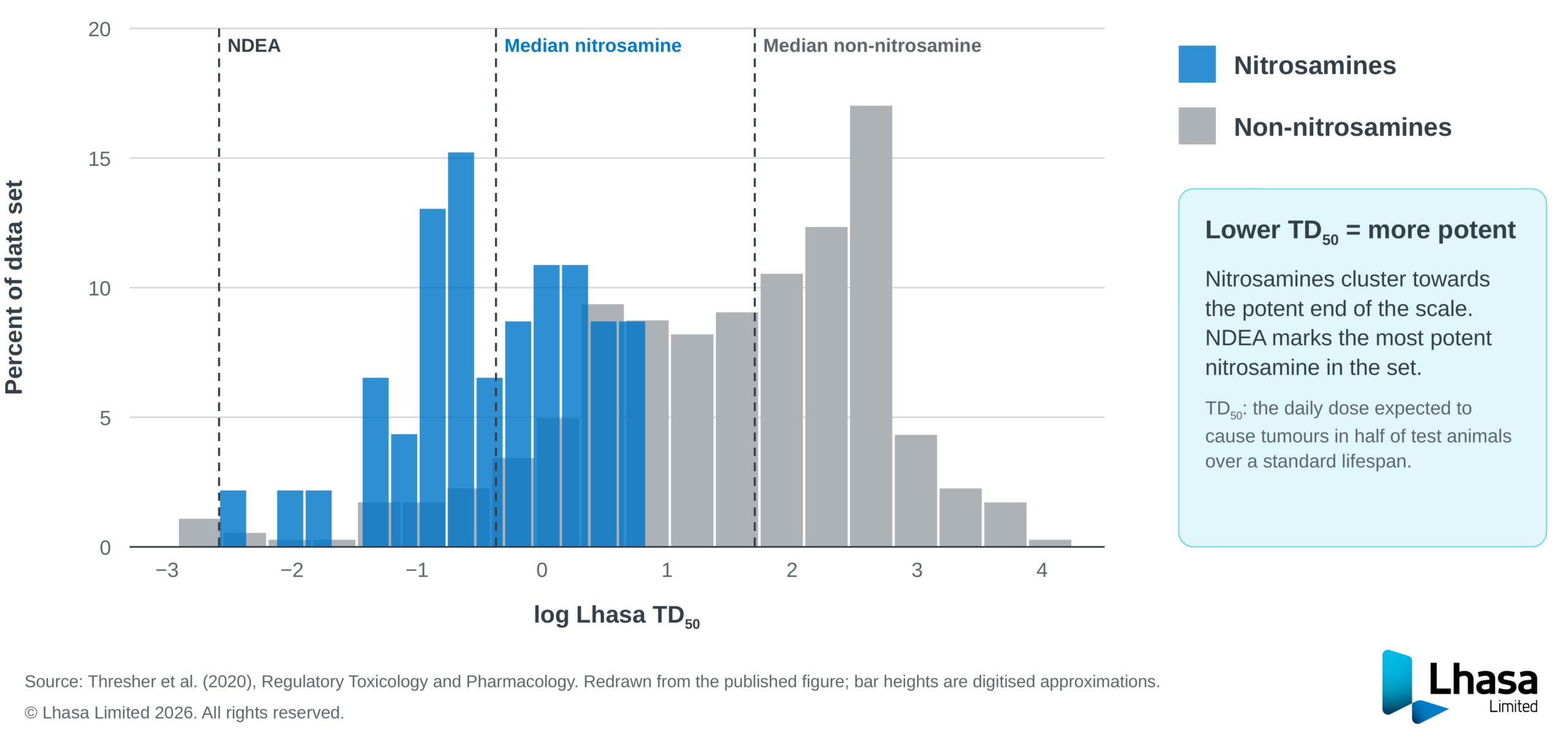
Because the default TTC of 1.5 µg/day isn’t reliably protective for these compounds, the guideline expects acceptable intakes to be set case by case, usually using carcinogenicity data from closely related structures. Nitrosamines have had the most attention since impurities were found in marketed medicines from 2018 onwards. Regulators now publish specific acceptable intakes and a structure-based potency categorisation approach for them.
Potency isn’t uniform within the cohort. A review of published data found that around 18% of the nitrosamines in an expanded dataset were non-carcinogenic, and that the potency ranges of nitrosamines and other carcinogens overlap considerably.
Hazard assessment and (Q)SAR
Why does ICH M7 require two complementary (Q)SAR methodologies?
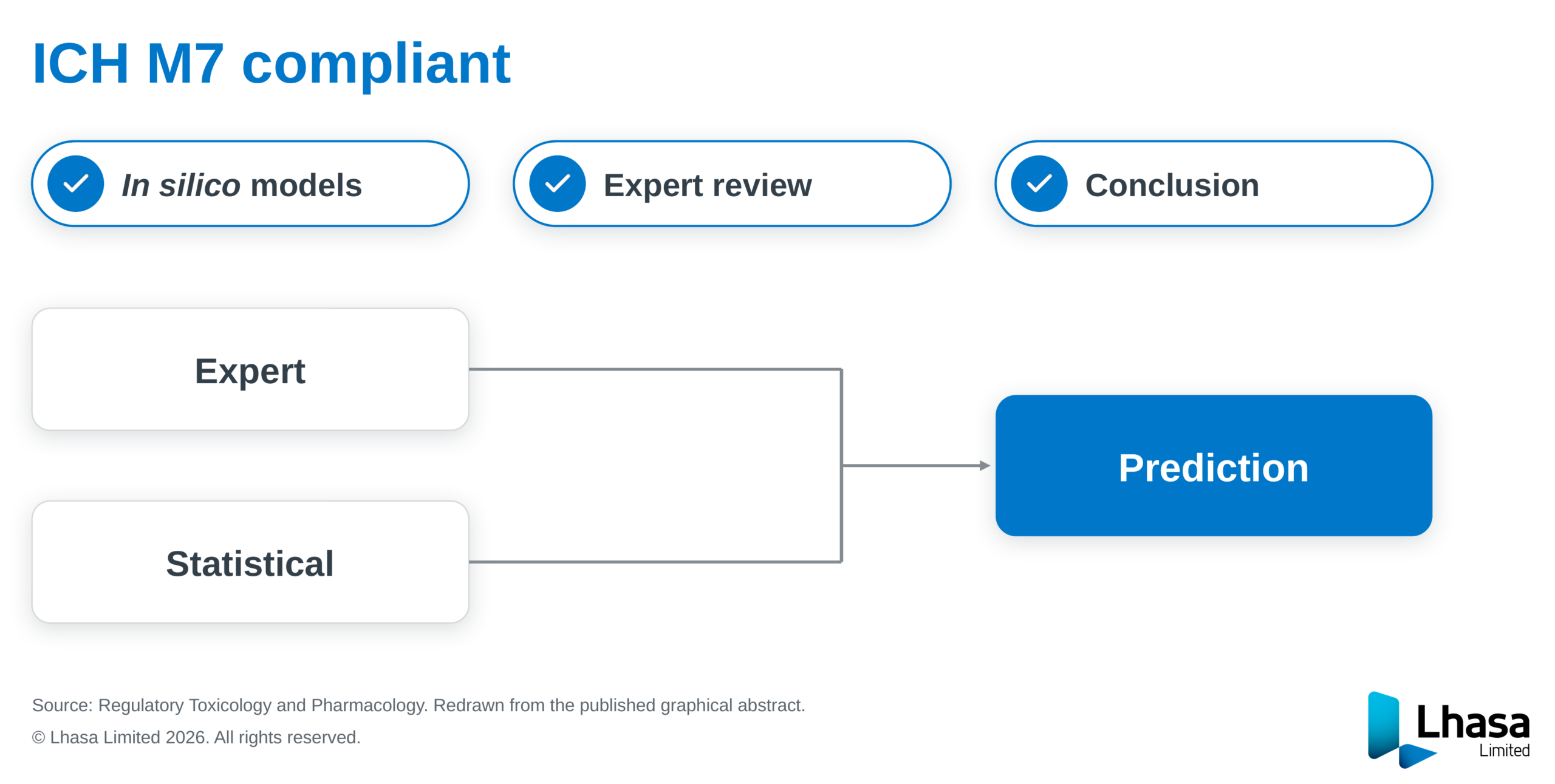
ICH M7 asks for two (Q)SAR methodologies that complement each other: one expert rule-based and one statistical. Both should follow the OECD validation principles. An expert rule-based system encodes mechanistic knowledge of which structures react with DNA. A statistical model learns patterns from experimental data without prior assumptions. Together they give a fuller picture of the evidence than either can alone.
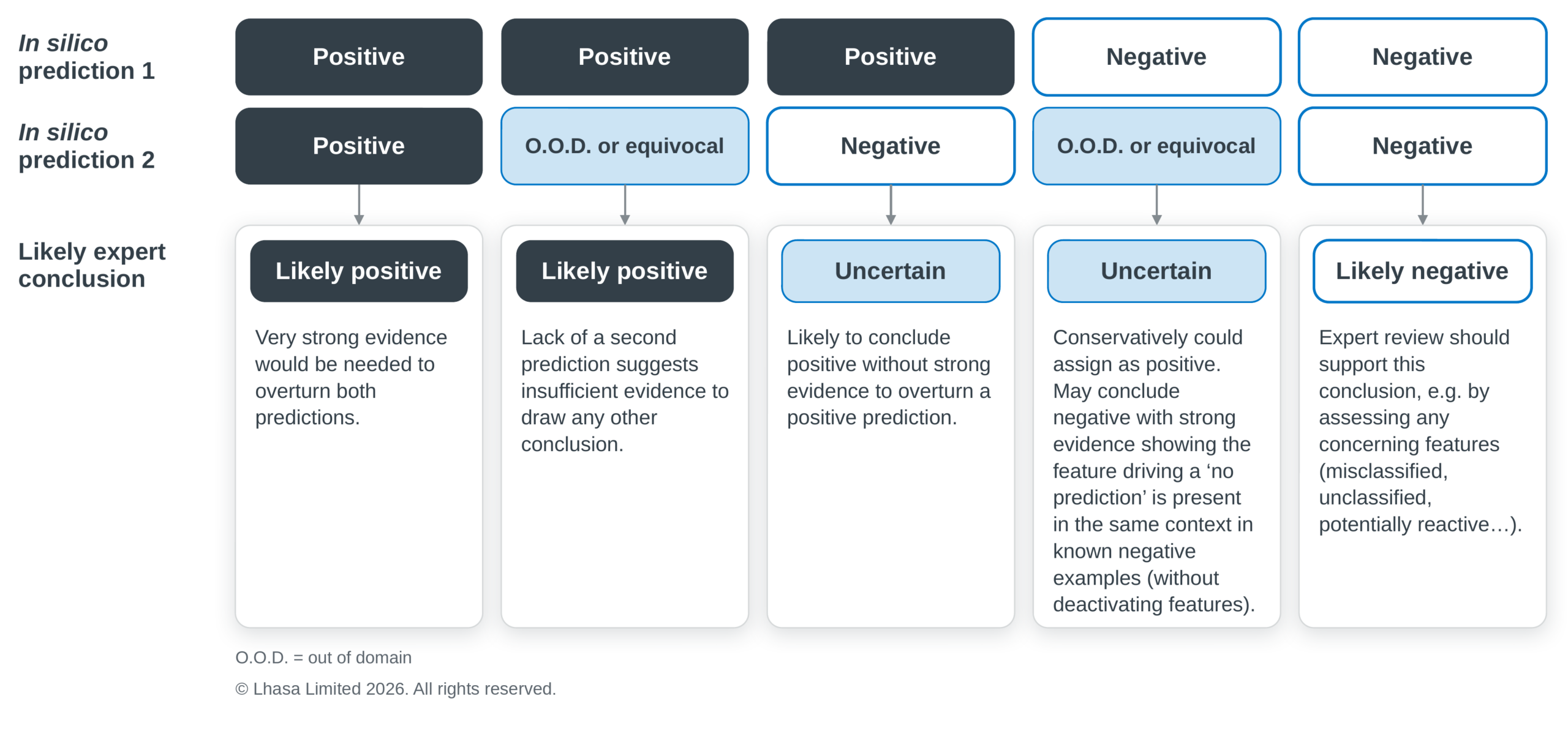
The two methods should be developed independently of each other. When both predict no mutagenic concern, that is enough to classify the impurity as Class 5 with no further testing. The two methods will sometimes disagree, and those cases need expert review.
What is the difference between an expert rule-based (Q)SAR system and a statistical (Q)SAR model?
An expert rule-based system is built from human expert knowledge. Specialists extract structural alerts and the features that switch them off, using experimental data, the literature and an understanding of the mechanism, and encode these as rules. A prediction therefore comes with a mechanistic explanation.
A statistical model is trained by an algorithm, using machine learning, on a dataset of compounds with known Ames results. It makes predictions from the patterns and similar compounds in its training data, so its strength is in picking up relationships that experts may not have written down. Each should make clear how it was built and when a compound falls outside its applicability domain.
Sources: [5]
Is (Q)SAR AI? What’s the difference between in silico, (Q)SAR and AI tools?
“In silico” covers any computer-based method. (Q)SAR is a specific type of in silico method that relates chemical structure to biological activity. “AI” is a broad umbrella term; statistical (Q)SAR models built with machine learning sit within it, while expert rule-based systems are knowledge-based rather than machine-learnt.
For ICH M7, the technique matters less than whether the model meets the OECD validation principles:
- a defined endpoint (the Ames test)
- an unambiguous algorithm
- a defined applicability domain
- appropriate measures of performance
- a mechanistic interpretation where possible
A tool that can’t explain what its prediction is based on, or tell you when a compound is outside its domain, isn’t a suitable replacement for a validated (Q)SAR model.
Do regulators accept (Q)SAR predictions in place of an Ames test under ICH M7?
Yes, as the initial assessment of mutagenic potential. ICH M7 states that if two complementary (Q)SAR methodologies find no structural alerts, the impurity has no mutagenic concern and no further testing is recommended (Class 5). These models predict the outcome of the Ames test (mutagenic potential), not mutagenicity in humans.
There are limits. An Ames result, where one exists, overrules a (Q)SAR prediction. Visual inspection for alerts isn’t enough on its own. Where an alert is found, you can either control the impurity at the TTC or run an Ames test to resolve the concern.
What is expert review of (Q)SAR predictions, and is it required by ICH M7?
ICH M7 defines expert knowledge as a review of existing data and any other relevant information to judge how accurate an in silico prediction is. Where warranted, it can be applied to any positive, negative, conflicting or inconclusive prediction, to add supporting evidence and give a rationale for the final conclusion.
It isn’t mandatory in every case: two negative predictions from complementary methods are enough for Class 5 on their own. It is effectively necessary in some situations. For example, if one model returns an out-of-domain or no-coverage result, the impurity can’t be classified as Class 5 without additional assessment.
Can existing data qualify an impurity without new mutagenicity testing?
Yes. Hazard assessment under ICH M7 starts with a search of databases and the literature for existing carcinogenicity and Ames data. If reliable data exist, the impurity can be classified as Class 1, 2 or 5 without new testing. Existing Ames data on the drug substance or related compounds can also support Class 4 where the impurity shares the same alert in the same chemical environment.
ICH M7 also recognises that an impurity may be a metabolite of the drug substance. In that case, the assessment that addresses the mutagenicity of the metabolite can qualify the impurity.
Sources: [1]
Classification
What are the five ICH M7 impurity classes and how is each controlled?
- Class 1
- Known mutagenic carcinogens. Control at or below a compound-specific acceptable limit.
- Class 2
- Known mutagens with unknown carcinogenic potential (Ames-positive, no rodent carcinogenicity data). Control at or below the appropriate TTC-based limit.
- Class 3
- An alerting structure unrelated to the drug substance, with no mutagenicity data. Either control at the TTC-based limit or run an Ames test. A negative result makes it Class 5; a positive result makes it Class 2.
- Class 4
- An alerting structure shared with the drug substance or related compounds that have been tested and found non-mutagenic. Treat as a non-mutagenic impurity.
- Class 5
- No structural alerts, or an alerting structure with enough data to show it isn't mutagenic or carcinogenic. Treat as a non-mutagenic impurity.
Class 1 is the highest concern and Class 5 the lowest. Classes 4 and 5 are then controlled under ICH Q3A and Q3B, like any other non-mutagenic impurity.
Related: Genotoxic impurity evaluation
Sources: [1]
What makes an impurity Class 4 rather than Class 3, and when is Class 5 justified?
Both Class 3 and Class 4 impurities contain a structural alert. What separates them is evidence. An impurity is Class 4 when it shares the alert with the drug substance or a related compound, such as a process intermediate, and that material has tested negative in the Ames test. The alert must be the same, in the same position and chemical environment. Without that tested comparator, an alerting impurity is Class 3.
Class 5 applies when there is no structural alert, or when there is an alert but enough data to show the impurity isn’t mutagenic or carcinogenic. The most common route is an appropriately conducted, negative Ames test on the impurity itself, which overrules any structure-based concern. Classes 4 and 5 are both treated as non-mutagenic, but they rest on different evidence and should be recorded separately.
Related: Genotoxic impurity evaluation
Risk characterisation and acceptable intakes
What is the Threshold of Toxicological Concern (TTC) in ICH M7, and when does it not apply?
The TTC is a default acceptable intake of 1.5 µg per person per day for a mutagenic impurity with no carcinogenicity data (Classes 2 and 3). It corresponds to a theoretical excess lifetime cancer risk of less than 1 in 100,000, based on a conservative linear extrapolation from rodent carcinogenicity data. So exceeding it doesn’t necessarily mean an increased cancer risk.
The TTC doesn’t apply to the cohort of concern. It also isn’t used when compound-specific carcinogenicity data allow a compound-specific or class-specific acceptable intake, or when there is evidence of a practical threshold that supports a permitted daily exposure. Higher intakes than 1.5 µg/day are allowed for shorter treatment durations.
Sources: [1]
What is the difference between the TTC and a compound-specific acceptable intake (AI)?
The TTC is a generic, precautionary default for a mutagen that hasn’t been studied for cancer. A compound-specific acceptable intake is derived from carcinogenicity data for that particular compound (Class 1). A class-specific AI can also be derived for a compound that is structurally similar to a well-characterised class of carcinogens, where a rationale and supporting data are provided.
A compound-specific AI can be much higher or much lower than the TTC. The ICH M7 Addendum lists values ranging from 0.004 µg/day for bis(chloromethyl)ether to 1,810 µg/day for ethyl chloride.
Related: AI/PDE data sharing
What is a TD50, and how is an acceptable intake calculated from it?
The TD50 is the chronic daily dose expected to cause tumours in 50% of animals over a standard lifespan, taking the background tumour rate into account. It is the most widely used measure of carcinogenic potency. By default, ICH M7 derives an acceptable intake by linear extrapolation: you divide the TD50 by 50,000 to reach a 1 in 100,000 risk level, then multiply by a 50 kg body weight.
The guideline example: ethylene oxide
21.3 mg/kg/day ÷ 50,000 × 50 kg = 21.3 µg/day
Rat TD50 ÷ 1 in 100,000 risk factor × body weight = acceptable intake
There are two alternatives:
- using a benchmark dose (BMDL10) divided by 10,000, which reflects the shape of the dose–response curve more directly
- using values already published by internationally recognised bodies such as the WHO International Programme on Chemical Safety
Related: AI/PDE data sharing
What are less-than-lifetime (LTL) limits in ICH M7, and how do acceptable intakes change with treatment duration?
Cancer risk assessment assumes risk depends on cumulative dose. ICH M7 therefore allows higher daily intakes for shorter treatments while keeping the total lifetime dose, and so the theoretical risk, comparable.
| Duration of treatment | Single impurity | Total, 3 or more Class 2/3 impurities |
|---|---|---|
| Up to 1 month | 120 | 120 |
| More than 1 month, up to 12 months | 20 | 60 |
| More than 1 year, up to 10 years | 10 | 30 |
| More than 10 years to lifetime | 1.5 | 5 |
The total limit applies when three or more Class 2 or Class 3 impurities are specified on the drug substance specification. For intermittent dosing, use the total number of dosing days, not the calendar period. The LTL approach can also be applied to compound-specific and class-specific AIs, but not to PDEs.
For nitrosamines, regional guidance applies. The FDA, for example, accepted LTL adjustment of recommended nitrosamine AIs for the first time on 24 September 2026, reversing its earlier position. Read our summary of the FDA update.
Why do different regulators set different acceptable intakes for the same impurity?
ICH M7 allows more than one scientifically valid way to derive a limit: linear extrapolation from a TD50 or a benchmark dose, a choice of which study, species and tumour site is most relevant, and use of published values. Even minor methodological differences, such as adjusting for body surface area, can produce slightly different limits.
The biggest differences today are for nitrosamines. Individual agencies publish their own acceptable intakes and potency categorisation approaches, and update these at different times as new data emerge. In practice, the limit that matters is the one expected by the agency you are submitting to, and the justification should rest on the most current data.
Related: Nitrosamine impurity risk assessment
Control strategy and purge
What are the four ICH M7 control options, and when can you justify Option 4 (no analytical testing)?
ICH M7 describes four ways to control a mutagenic impurity in the drug substance.
- Option 1
- Test the drug substance at or below the acceptable limit.
- Option 2
- Test an upstream material, or use an in-process control, at or below the acceptable limit.
- Option 3
- Test upstream at a higher limit, supported by demonstrated knowledge of the impurity's fate and purge.
- Option 4
- Rely on process understanding alone, with no test for the impurity.
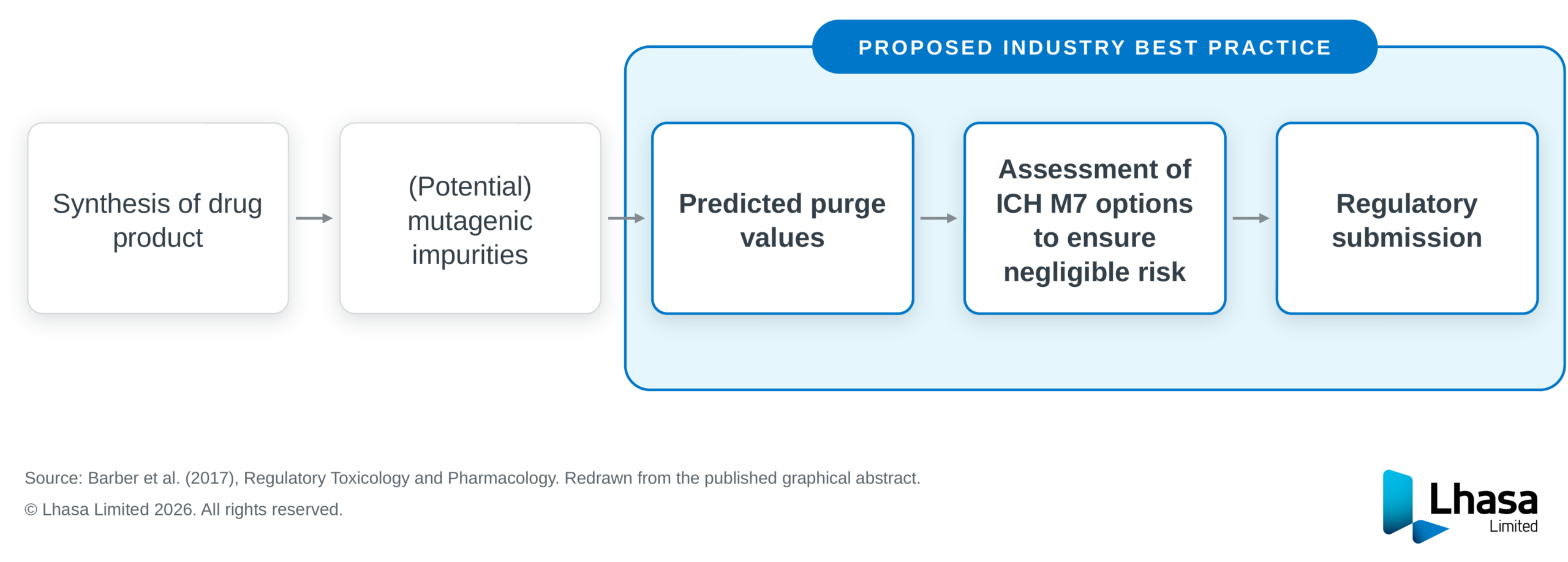
Option 4 is appropriate when the risk of the impurity being present in the final drug substance is negligible. If predictive purge calculations show the impurity would be below 1% of the TTC or AI, the risk can be considered negligible. If predictions show more than 1%, measured purge data (such as spike-and-purge experiments) showing levels below 10% should be provided. Option 4 suits inherently unstable impurities and those introduced early and purged effectively; for impurities introduced in the last synthetic step, Option 1 is normally expected.
Related: Impurity and degradant control
What is a purge factor, and how do you build a purge argument?
A purge factor measures how well a process step reduces an impurity: the impurity level before the step divided by the level after it. It can be predicted or measured. Predicted purge factors are based on the impurity’s physicochemical properties and the process conditions: reactivity, solubility, volatility, ionisability and any physical steps designed to remove impurities. Factors for each step are multiplied to give an overall predicted purge for the route.
The overall purge is then compared with the purge needed to bring the impurity below its acceptable limit. How much supporting evidence you need depends on the margin: a large margin can be justified by calculation alone, while smaller margins need literature support and analytical data. Regulators expect calculations to follow the process as described in the application, use conservative values, and give more detail as the predicted level approaches the limit.
Related: Impurity and degradant control
Guideline context
Do impurities controlled at the TTC need to be monitored in stability studies?
Yes, for degradation products. For a potential degradation product characterised as mutagenic, you first need to show whether the degradation pathway is relevant. The recommended way is a well-designed accelerated stability study (for example 40 °C/75% relative humidity for 6 months) in the proposed packaging. If results suggest the degradation product could form at levels approaching the acceptable limit, efforts to control its formation are expected, and monitoring in long-term primary stability studies is also expected unless otherwise justified.
Related: Impurity and degradant control
How does ICH M7 relate to ICH Q3A and Q3B, and which guideline applies to non-mutagenic impurities?
ICH Q3A and Q3B set the thresholds for reporting, identifying and qualifying most impurities in new drug substances and products. ICH M7 complements them by dealing specifically with impurities that are DNA-reactive. Impurities classified as Class 4 or Class 5 under ICH M7 are treated as non-mutagenic and handled under Q3A and Q3B.
For mutagenic potential, ICH M7 replaces the need for further qualification: below or above the Q3A/Q3B qualification thresholds, no further qualification for mutagenicity is required. One additional consideration remains: where an impurity exceeds 1 mg per day in chronic use, genotoxicity evaluation as recommended in Q3A/Q3B could be considered.
Related: Non-genotoxic impurity assessment
Sources: [1]
Cite & reference Lhasa ICH M7 science
Cite this image in your research
Barber C, Amberg A, Custer L, Dobo KL, Glowienke S, Van Gompel J, Gutsell S, Harvey J, Honma M, Kenyon MO, Kruhlak N, Muster W, Stavitskaya L, Teasdale A, Vessey J, Wichard J (2015). Establishing best practise in the application of expert review of mutagenicity under ICH M7. Regulatory Toxicology and Pharmacology 73(1):367–377.
Figure adapted from Barber et al. (2015). © Lhasa Limited.
Cite this image in your research
Barber C, Hanser T, Judson P, Williams R (2017). Distinguishing between expert and statistical systems for application under ICH M7. Regulatory Toxicology and Pharmacology 84:124–130.
Figure adapted from Barber et al. (2017). © Lhasa Limited.
Distinguishing between expert and statistical systems for application under ICH M7
Cite this image in your research
Thresher A, Foster RS, Ponting DJ, Stalford SA, Tennant RE, Thomas R (2020). Are all nitrosamines concerning? A review of mutagenicity and carcinogenicity data. Regulatory Toxicology and Pharmacology 116:104749.
Figure adapted from Thresher et al. (2020). © Lhasa Limited.
Cite this image in your research
Barber C, Antonucci V, et al. (2017). A consortium-driven framework to guide the implementation of ICH M7 Option 4 control strategies. Regulatory Toxicology and Pharmacology 90:22–28.
Figure adapted from Barber et al. (2017). © Lhasa Limited.
Regulatory support
ICH M7
ICH M7 recommends two complementary (Q)SAR methodologies: one expert rule-based and one statistical. Lhasa Limited provides both. Derek Nexus (Lhasa Limited) gives the expert rule-based prediction, and Sarah Nexus gives the statistical prediction. Used together, they meet the ICH M7 recommendation and support a full impurity classification.
References
- ICH (2023). M7(R2): Assessment and control of DNA reactive (mutagenic) impurities in pharmaceuticals to limit potential carcinogenic risk. Adopted 3 April 2023. View source
- ICH (2023). Addendum to M7(R2): Application of the principles of the ICH M7 guideline to calculation of compound-specific acceptable intakes. Adopted 3 April 2023. View source
- ICH (2022). M7(R2) Questions and Answers. Adopted 24 May 2022; error correction issued 24 May 2023. View source
- Barber C, et al. (2017). A consortium-driven framework to guide the implementation of ICH M7 Option 4 control strategies. Regul Toxicol Pharmacol 90:22–28. View source
- Barber C, Hanser T, Judson P, Williams R (2017). Distinguishing between expert and statistical systems for application under ICH M7. Regul Toxicol Pharmacol 84. View source
- Barber C, Amberg A, Custer L, et al. (2015). Establishing best practise in the application of expert review of mutagenicity under ICH M7. Regul Toxicol Pharmacol 73:367–377. View source
- Amberg A, et al. (2016). Principles and procedures for implementation of ICH M7 recommended (Q)SAR analyses. Regul Toxicol Pharmacol 77:13–24.
- Teasdale A, et al. (2013). Risk assessment of genotoxic impurities in new chemical entities: strategies to demonstrate control. Org Process Res Dev 17:221–230.
- Thresher A, Foster RS, Ponting DJ, Stalford SA, Tennant RE, Thomas R (2020). Are all nitrosamines concerning? A review of mutagenicity and carcinogenicity data. Regul Toxicol Pharmacol 116:104749. View source
- Felter SP, Mudd AM, Ponting DJ, Thomas R, et al. (2025). Evaluating the lifetime cumulative dose as a basis for carcinogenic potency of nitrosamines. Regul Toxicol Pharmacol 162:105903. View source
- FDA CDER (2026). Application of less-than-lifetime adjustment to nitrosamine impurities. Guidance update, 24 September 2026. View source
These answers summarise the guideline for general understanding. For regulatory submissions, always refer to the current ICH text and the expectations of the relevant authority.