
Zeneth Preformulation: Predict Compatible Formulations Before You Run a Single Experiment
Zeneth Preformulation gives formulation scientists a rapid, in silico compatibility assessment of API–excipient combinations, so your team spends less time eliminating options in the lab and more time building the formulation that works.
Selecting the right excipients is one of the most time-intensive decisions in early drug development. A poor compatibility choice identified late in the process can delay timelines, waste experimental resource, and compromise drug product stability. Zeneth Preformulation helps you make those decisions earlier and with greater confidence, using the same expert knowledge base that underpins the established Zeneth forced degradation platform.
Request a demo of Zeneth Preformulation
Features and benefits
Assess compatibility at the design stage
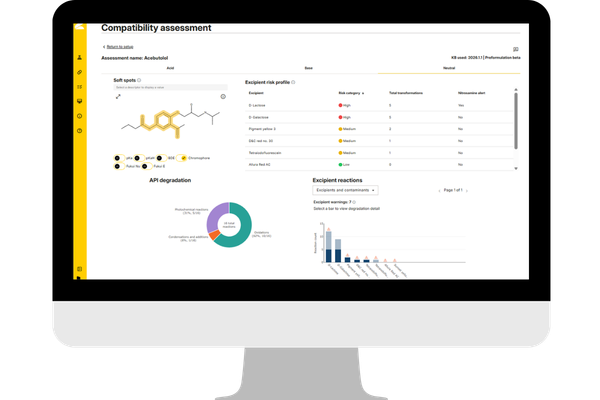
Evaluate API–excipient combinations in silico before committing to physical compatibility studies. Zeneth Preformulation draws on a curated knowledge base of degradation chemistry and excipient interactions to identify potential incompatibilities and flag areas of concern, giving your team a scientifically grounded starting point for formulation design
Reduce the analysis burden
Rather than manually reviewing a full set of compatibility data, formulation scientists can use Zeneth Preformulation to quickly surface the combinations most likely to produce a stable drug product. The software ranks compatibility findings and presents them in a structured workflow, reducing the time from question to actionable insight.
Support ICH Q1A(R2)-aligned stability decisions
Zeneth Preformulation is designed to support early formulation decisions that feed into stability testing programmes consistent with ICH guidelines. By identifying likely stability challenges at the preformulation stage, teams can design experimental programmes more efficiently and document a clearer scientific rationale for regulatory submissions.
Frequently asked questions
What is Zeneth Preformulation?
Zeneth Preformulation is an in silico software module from Lhasa Limited that assesses the compatibility of active pharmaceutical ingredient (API) and excipient combinations at the preformulation stage of drug development. It uses a curated knowledge base of degradation chemistry to identify potential incompatibilities before experimental studies begin — helping formulation teams make faster, more confident decisions at the design stage.
How does excipient compatibility assessment work in Zeneth Preformulation?
Zeneth Preformulation evaluates the structural features of an API against a database of over 350 common pharmaceutical excipients, drawing on established degradation chemistry to predict potential interactions. It identifies combinations that carry compatibility risk, highlights the structural areas of the API most likely to drive those interactions, and presents findings in a structured workflow.
At what stage of drug development should I use Zeneth Preformulation?
Zeneth Preformulation is designed for the preformulation stage — typically early phase development, before a formulation strategy is finalised. Using the software at the design stage means potential API–excipient incompatibilities are identified before physical compatibility studies begin, reducing experimental iterations and informing decisions earlier in the timeline.
Does Zeneth Preformulation replace physical compatibility studies?
No. Zeneth Preformulation is designed to inform and reduce the scope of physical compatibility studies, not replace them. The in silico assessment helps formulation scientists identify which API–excipient combinations carry the most risk before experimental work begins, so experimental resource can be focused on the combinations that matter most.
Who is Zeneth Preformulation designed for?
Zeneth Preformulation is built for preformulation and formulation scientists, CMC teams, and scientists preparing formulation rationale for regulatory submissions. It is particularly useful for organisations working on multiple formulation candidates in parallel who need to assess compatibility efficiently and document a clear scientific rationale for their choices.