
Establishing best practice for N-nitrosamine read-across and surrogate selection

Regulatory Toxicology and Pharmacology, Volume 166, March 2026
By David Ponting, Gabriela de Oliveira Silveira, Philip Rowell, Crina Heghes, Adrian Fowkes and Christopher Barber


A reproducible, regulator-aligned framework for confidently selecting nitrosamine read-across analogues
The best-practice method outlined in this paper illustrates how toxicologists can:
- remove assessor subjectivity
- increase acceptance likelihood
- enable higher, science-justified acceptable intake
(AI) limits for nitrosamine drug substance-related
impurities (NDSRIs)Making read-across usable in practice.
Increase in AI limit using read-across vs. CPCA for N-nitroso-paroxetine.
AI increase to 1900 ng/day for N-nitroso-trientine via read-across vs. CPCA.
potential N-nitroso analogues for users to access and evaluate.
time saved using Lhasa read-across tool Acrostic.
Most nitrosamine limits rely on default CPCA categorisation, not compound-specific evidence
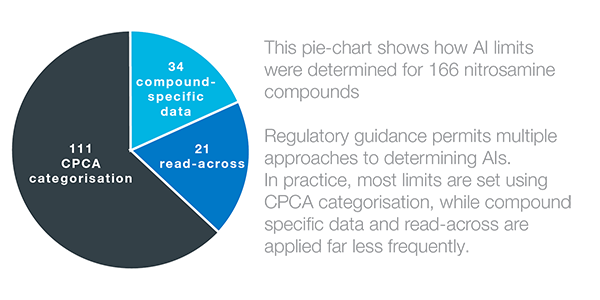
Read-across is accepted, but remains uncommon, due to it being difficult to apply consistently - underscoring the need for a robust, repeatable framework.

Read-across is powerful, but without standardisation, two experts can reach two very different conclusions. This is due to factors such as subjective differences in perception of similarity or data quality.
This framework brings transparency, reproducibility and therefore confidence to nitrosamine surrogate selection.
Continue reading
Unlock this full infographic to see best practice frameworks, how to submit realistic acceptable limits outside of the CPCA and an actionable blueprint for reproducible read-across.
Best-practice read-across enables more realistic acceptable intakes
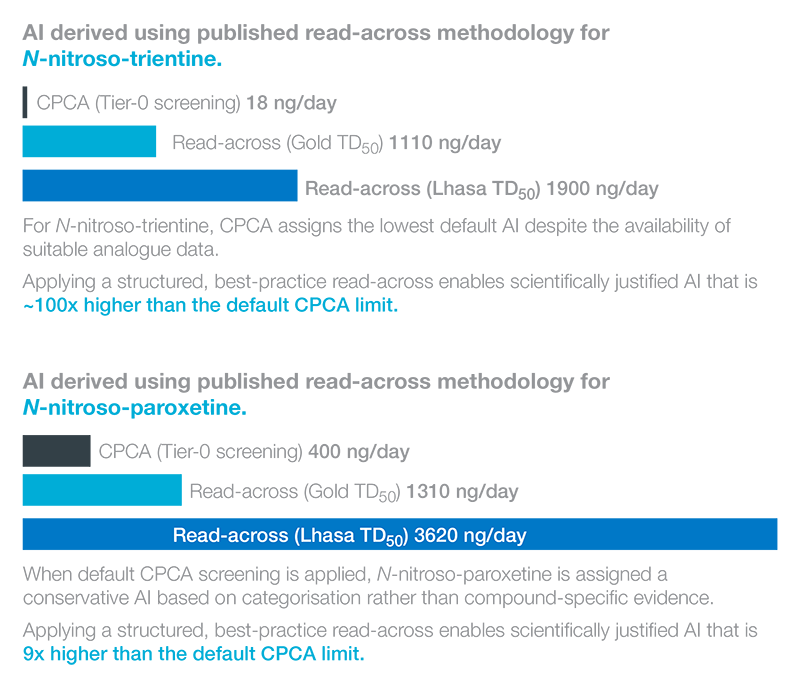
Applying a structured, best-practice read-across enables more realistic compound specific AI limits while maintaining patient safety. This reduces unnecessary recalls and supports continued medicine supply.

A best-practice framework for nitrosamine read-across
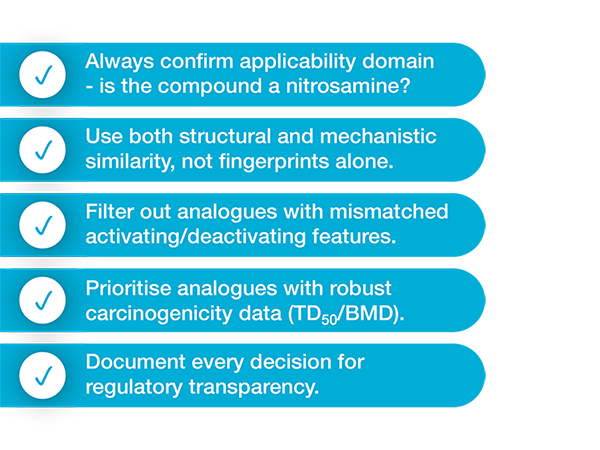
Define the applicability domain
Identify the structural and mechanistic features that drive nitrosamine potency. Confirm the compound fits the N-nitrosamine space.
Retrieve, filter and rank analogues systematically
Apply structural filters (toxicophores, activating/ deactivating groups) and rank analogues using local similarity, logP, mechanistic relevance, and global similarity metrics.
Expert review with transparent documentation
Assess carcinogenicity data quality, evaluate uncertainty, and clearly document the rationale to support regulatory acceptance.

Using in silico tools for a structured approach to best practice read-across, resulting in defensible decisions
A six-phase workflow that turns nitrosamine read-across guidance into reproducible, regulator-aligned outcomes:
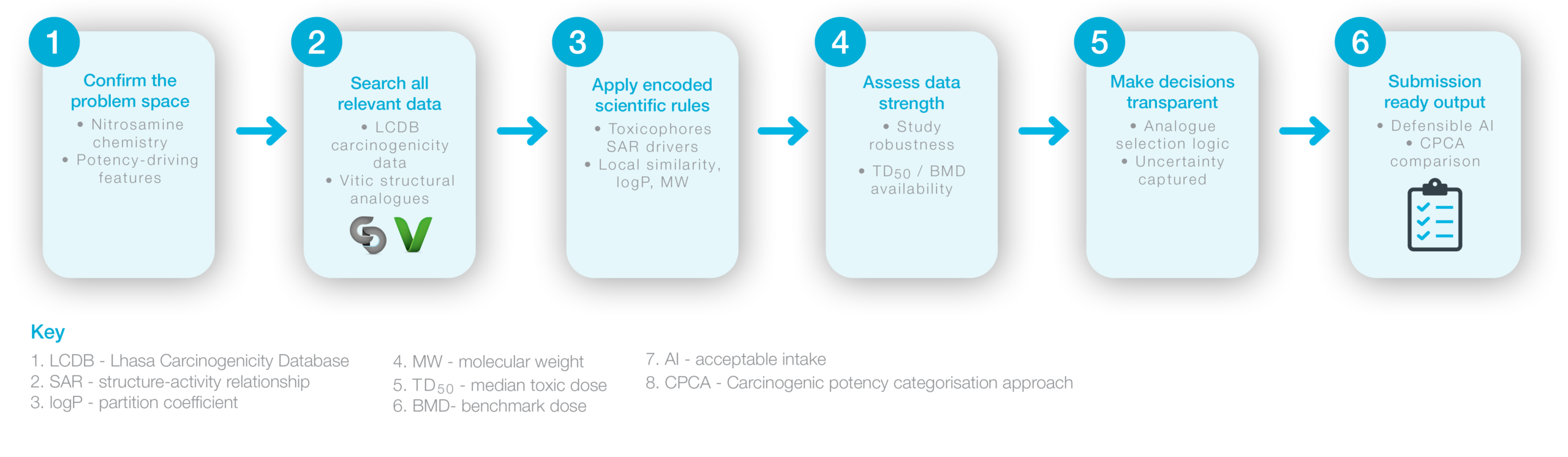
An actionable blueprint for defensible read-across
Key steps to support transparent, reproducible, and regulator-aligned nitrosamine read-across decisions.
Designed by scientists for scientists, Lhasa bridges industry and regulators to advance safer, more reliable chemical risk assessment.
This best-practice approach supports confident chemical safety decisions for the benefit of human health, reflecting the Lhasa purpose.
By enabling transparent and reproducible, read-across, Lhasa in silico solutions help organisations reach scientifically justified conclusions and support successful regulatory submissions without animal testing.
Approval number: LHS-PB-001 | © Lhasa Limited 2026. All rights reserved
Lhasa Limited | Granary Wharf, Leeds, LS11 5PS, UK