Nitrosamine impurities form when unreported changes to a synthetic process create the right conditions for an unwanted reaction, as one pharmaceutical company learned when this exact scenario led to a global recall. The result was a recall of several hypertension, heartburn, and diabetes medications, and an investigation that reshaped how the industry thinks about impurity risk.
The nitrosamines crisis
While many impurities are introduced directly as reagents, potentially mutagenic impurities (PMIs) that arise during manufacture can be harder to identify, since they can occur indirectly from a combination of otherwise non-mutagenic sources.
The case: an unreported change in the synthetic process for Valsartan brought sodium nitrite into contact with dimethylamine, present as an impurity in the solvent dimethylformamide. That combination formed NDMA. Regulators moved fast, and the recall extended to every related medicine on the market.
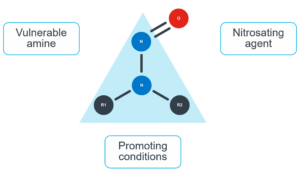
This is the pattern behind nearly every nitrosamine formation case, and it’s often described as a triangle: a vulnerable amine, a nitrosating agent, and conditions that favour the reaction between them. All three have to be present for a nitrosamine to form. In the Valsartan case, dimethylamine supplied the vulnerable amine, sodium nitrite supplied the nitrosating agent, and the unreported process change supplied the conditions. Remove any one point of that triangle and the impurity doesn’t form.
What makes this kind of impurity dangerous isn’t that it’s unusual. It’s that it’s invisible until it isn’t. Nobody added a mutagenic reagent. Two ordinary, individually low-risk components met under the wrong conditions, and a process change nobody flagged as significant created the opening.
Identifying that kind of risk relies on knowing the synthetic route inside out: not just the reagents you intended to use, but every substance and condition present at every stage, including the ones inherited from raw material impurity profiles or solvent choices made for unrelated reasons. That’s a harder standard to meet than it sounds, and it’s easy to assume a process is well understood simply because it’s well documented.
The question worth sitting with isn’t whether your synthesis is compliant on paper. It’s whether you’d catch a Valsartan-style combination if it existed in your own process today.
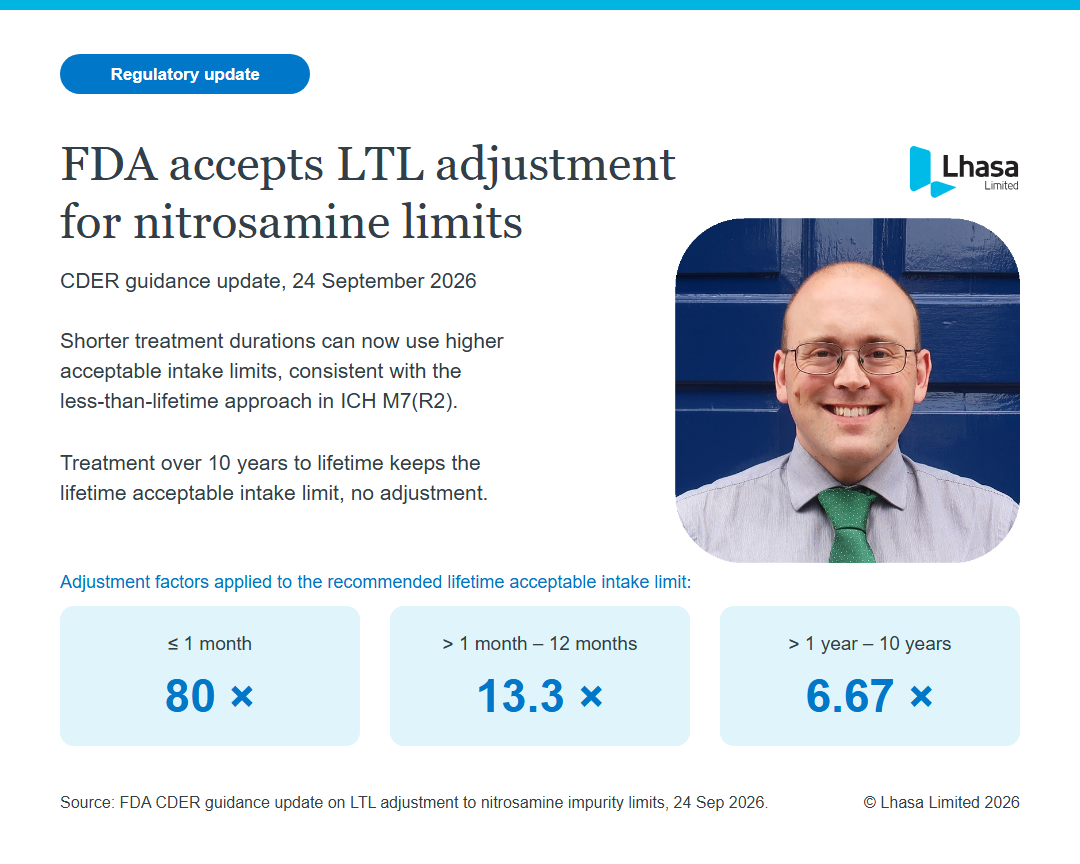
Guidance on acceptable intake levels for Nitrosamine Drug Substance-Related Impurities (NDSRIs) has continued to evolve since this case. Our recent blog articles discuss the updates from the EMA and the FDA in more detail. We published an explainer on FDA’s September 2026 guidance update on less-than-lifetime limits available now.
Valsartan was recalled after nitrosamine impurities, specifically NDMA, were detected in marketed batches. Investigation traced the cause to an unreported change in the synthetic manufacturing process, which brought sodium nitrite into contact with dimethylamine present as an impurity in a solvent, forming NDMA as an unintended by-product.
NDMA (N-nitrosodimethylamine) is a nitrosamine, a class of compounds classified as probable human carcinogens. Its presence in a drug product above acceptable intake limits is a patient safety concern, which is why its detection in Valsartan triggered a global recall.
Nitrosamine Drug Substance-Related Impurities are nitrosamine impurities that form from a reaction involving the drug substance itself, distinct from process-related nitrosamines like the one found in Valsartan. Regulatory bodies have issued specific guidance on acceptable intake limits for this category.
Nitrosamines can form when a nitrosating agent, such as sodium nitrite, comes into contact with an amine, such as dimethylamine, under the right reaction conditions. These components are often present for unrelated reasons, as reagents, solvent impurities, or by-products elsewhere in the process, which makes the risk harder to spot than a directly added mutagenic reagent.
Yes. The Valsartan case is the best-known example, but the underlying mechanism, individually low-risk substances combining under process conditions, isn’t unique to one drug or one company.
Yes. Regulatory bodies including the EMA and the FDA have issued updated guidance on nitrosamine impurity risk assessment and acceptable intake limits since this case.
Last Updated on October 8, 2026 by lhasalimited