
Approaching regulatory compliance with confidence
ICH Q3D guidelines require assessing and controlling elemental impurities for regulatory compliant development of drug products. The workflow emphasises a risk-based control strategy to limit elemental impurities, which can be derived from residual catalysts, raw materials, reagents that can be present in the API or excipient of the drug product.
The guideline also ensures safety and quality throughout the drug life cycle since drug products require re-assessment if they are susceptible to any changes in formulation, API or excipients routes of synthesis, supplier production or grade of raw materials.
Vitic Q3D is an in silico solution from Lhasa Limited which approaches ICH Q3D risk assessments using automated calculations. These are powered by pre-existing experimental data, namely donations from the Elemental Impurities Data Sharing Initiative.
Expert-curated elemental impurities data powers Vitic Q3D’s capabilities and allows pharmaceutical organisations to identify impurity sources, develop control strategies and comply with regulatory expectations.
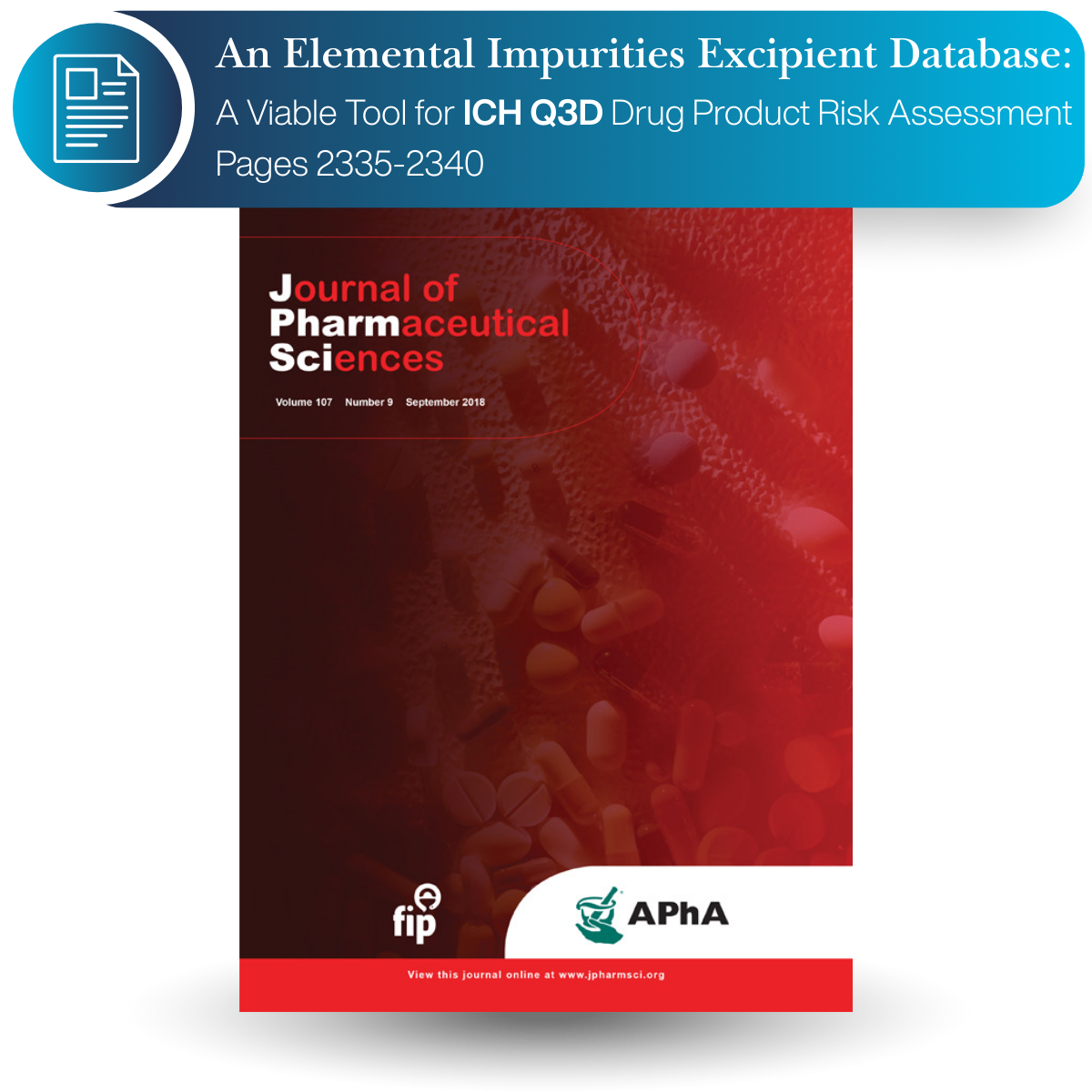
In this blog, we will focus on an interesting publication from the Journal of Pharmaceutical Sciences that confirms the scientific foundation of the elemental impurities database which is at the centre of the Vitic Q3D tool from Lhasa Limited.
In collaboration with industry experts, the practical implementation of ICH Q3D guidelines using this expansive database provided good coverage of real-world drug product formulations and tested elemental profiles consistent with ICH Q3D recommendations.
From here, innovative functions of Vitic Q3D can simplify Q3D compliance through automated calculations, streamlined data identification, reduced time spent on referencing guidelines and the mitigated need for analytical testing.
Not only does Vitic Q3D reduce the annual costs and time dedicated to performing assessments in line with ICH Q3D guidelines, but it also helps balance Three R requirements. At the forefront, however, is the benefit of the robust dataset, which aligns the tool with regulatory submission from the outset.
The power of our expertly-reviewed elemental impurities database
For decades, Lhasa Limited has supported shared knowledge, shared progress initiatives. This includes a series of precompetitive data sharing consortiums which support risk assessments by providing access to high-quality, collaborative data.
The elemental impurities consortium of leading pharmaceutical companies and major regulatory authorities, in particular, has helped develop an expansive & complete dataset which is now also hosted in Vitic Q3D.
(Boetzel et al., 2018, p. 2337)
Vitic Elemental Impurities is the largest dataset of its kind. This means that any calculations performed using Vitic Q3D has the maximum coverage of pre-existing experimental data which directly improves the confidence of decisions made a part of the Q3D assessment.
(Boetzel et al., 2018, p. 2336)
The database includes:
for an excipient
batch-to-batch variability
testing methods
The impact of the data is invaluable, as outlined by the publication, since the depth of the data also reflects real-world variation.
From this, the data can be used in real-time assessments whilst still accounting for supplier or batch changes, ensyring defensible risk modelling.
The data also demonstrates rigour. Only data that is generated from validation methodology is accepted by the Elemental Impurities Data Sharing Initiative and peer reviewed by our in-house Lhasa Scientists before being added. This makes assessments of each excipient both objective and robust.
Its comprehensiveness reassures users that specific excipients are likely included.
The elemental impurities database and peer-review efforts of the leading consortium lay a foundation of industry and regulatory assurance. As the only collection of data of this type, any Q3D assessments performed using Vitic Q3D will automatically achieve enhanced data accuracy and quality, transcending into improved confidence.
Confirmation of regulatory aligned ICH Q3D recommendations
By evaluating the publications we can see that the Vitic the elemental impurities data is aligned with ICH Q3D recommendations, with scientific validity of the consortium-derived data demonstrated through two critical findings:
- The study which confirms the dataset is inclusive across all ICH Q3D mandated elements.
- The study also addresses that the data can produce a bias towards safety through statistical conservatism which aligns with risk assessment.
What is paramount from the publication, however, is the confirmation on earlier findings that elemental concentrations in excipients are generally low across the board.
As the largest study on this topic, the dataset can confirm that elemental impurities above the official safety limits are highly unlikely. This makes justification of low-risk conclusions easily achieved through the peer reviewed data.
(Boetzel et al., 2018, p. 2340)
Since the elemental impurities data shows risk is consistently low, time and money can be saved through the validated risk assessment approach and mitigating the need for mandatory full testing.
Critically, the paper also confirms the active use of the elemental impurities database from Lhasa Limited as a line of evidence in ICH Q3D risk assessments. Published in 2018, the proven use of this data in elemental impurity risk assessments is since prevalent across the last seven years.
Successful use cases evidencing the elemental impurities database led to the development of Vitic Q3D. By enhancing this validated, regulatory-backed database with automated calculation capabilities, you have a de-risked compliance pathway.
Combining data validation with automated ICH Q3D calculations
Approaching risk assessment for ICH Q3D using Vitic Q3D tool adds credibility to your assessment reports. The in silico solution leverages the dataset, which is housed directly within the tool, to identify impurity sources and ensure that appropriate levels of control can be established.
Lhasa Limited designed the consortium to have regulatory input and visibility as a goal of the elemental impurities database. With this, we can ensure that Vitic Q3D is inherently positioned for confident compliance.
In the longer term, Vitic Q3D contributes towards ruling out extensive, costly testing on low-risk excipients and instead encourages the transparent use of collective industry and regulatory data. That is the power of data sharing initiatives at Lhasa Limited, explore collaboration opportunities here.
If you’re ready to align your ICH Q3D risk assessments with regulatory compliance, demo our high-quality elemental impurities database and automation tool now! Book here.
References
Boetzel, R., Ceszlak, A., Day, C., … Teasdale, A., Thompson, S., & Wilkinson, D. (2018) ‘An Elemental Impurities Excipient Database: A Viable Tool for ICH Q3D Drug Product Risk Assessment’, Journal of Pharmaceutical Sciences, 107, pp. 2335–2340. Available at: https://jpharmsci.org/article/S0022-3549(18)30212-0/fulltext (Accessed: 2 February 2026).
Last Updated on February 4, 2026 by lhasalimited