
FDA Research Collaboration Agreement
Making use of publicly releasable FDA data to make improvements to our software
The FDA RCA (Research Collaboration Agreement) is a 5-year project between Lhasa Limited and the FDA/CDER (U.S. Food and Drug Administration’s Center for Drug Evaluation and Research).
The agreement aims to make use of publicly releasable FDA data to make improvements to software from Lhasa Limited.
Initiated in November 2011, following the agreements 5-year completion in 2016, the RCA was extended for an additional 5-years, to November 2021. Effective from November 2021, the term of the RCA was extended again for an additional five years to the new expiration date of November 2026.
The RCA was initiated on culmination of previous 5-year agreements and aims to make use of publicly releasable FDA data to construct, improve and validate our software for toxicity, metabolism, chemical degradation, and impurity purge factor prediction.
The following points provide a greater insight into the collaboration between us (Lhasa Limited) and the U.S. Food & Drug Administration (FDA):
We have always worked on the basis of ‘shared knowledge, shared progress’ and it is at the heart of our charitable purpose. Our collaboration with the FDA aligns with this premise, ensuring that the sharing of knowledge benefits both the public and the broader scientific community.
The FDA shares publicly releasable data sets with Lhasa Limited. This data, combined with our curated data sets harvested from literature and our member data, is then used to train, and improve our software solutions.
The FDA use their non-publicly releasable data sets to evaluate and provide feedback on the performance of our tools.
To date, FDA/CDER has shared publicly releasable data with us for a variety of toxicity endpoints including:
Rodent carcinogenicity
Genetic toxicity
Reproductive toxicity
Urinary tract toxicity
Cardiotoxicity
As part of this collaboration, the FDA provides feedback and guidance on our developments from a regulatory perspective, and these are shared with the scientific community through joint publications.
Work carried out under this collaboration also includes exploitation of in vitro and other relevant data, in addition to in vivo DART* information towards the prediction of molecular initiating events relevant to teratogenicity. This initiative looks to provide predictions over a significantly wider chemical space.
*DART (Developmental and Reproductive Toxicology Database)
Benefits
There are numerous benefits to this collaboration including:
Continuous industry-led improvement
Through collaboration with the FDA, our software is consistent with FDA requirements. This offers peace of mind when submitting predictions from our software to regulators.
Shared knowledge, shared knowledge
The science explored, and any corresponding features and findings generated, from this collaboration are often shared with the wider scientific community through publications in journals or at relevant conferences.
Data quality
Mining of publicly releasable FDA data sets has led to the development of new alerts in Derek Nexus, which provides users with a more robust prediction.
Declaration
FDA’s participation
FDA’s participation in the current Research Collaboration Agreement (RCA) should not be interpreted as a direct or indirect endorsement of any Lhasa product or service. The FDA/CDER maintains similar RCAs with multiple organisations to facilitate data sharing, model development, and access to computational toxicology software.
Related publications
Paper
- Jun 2026
- Carcinogenicity assessment, Data sharing, NAMs Strategy, UK Government Replacing Animals In Science Strategy
Paper
- Jun 2026
- Data sharing, In silico mutagenicity assessment, NAMs Strategy
Paper
- Apr 2026
- Data sharing, Nitrites
Recent blogs
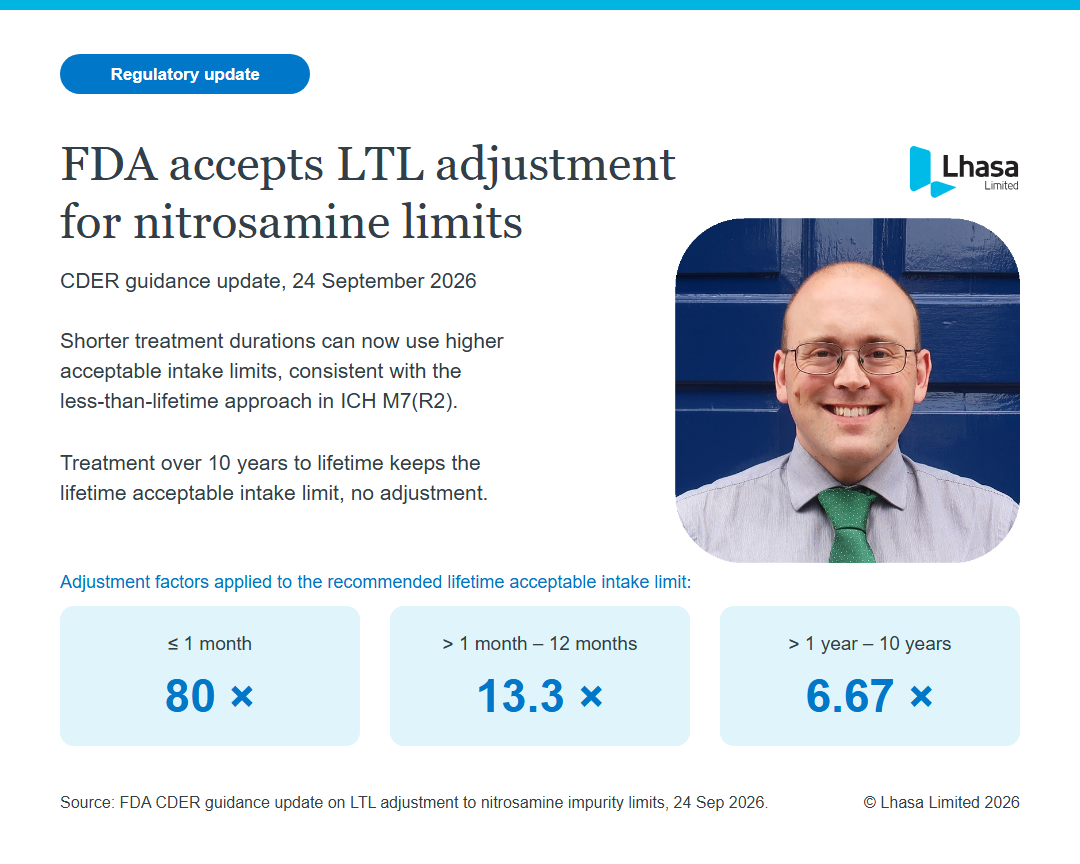
by David Ponting, Senior Principal Scientist, Lhasa Limited On 24 September 2026, the US Food and Drug Administration (FDA) published a guidance …
Forced degradation study design that is both defensible and efficient requires insight into the specific reactivity of an API before work begins …
As governments and regulators across the UK, EU and beyond move to reduce reliance on animal testing, the need for reliable and …