by David Ponting, Senior Principal Scientist, Lhasa Limited
On 24 September 2026, the US Food and Drug Administration (FDA) published a guidance update, “Application of Less-Than-Lifetime Adjustment to Nitrosamine Impurities”, on the Center for Drug Evaluation and Research (CDER) nitrosamine guidance web page. For the first time, the FDA accepts that less-than-lifetime (LTL) adjustment factors, consistent with the framework in ICH M7(R2), may be applied to recommended acceptable intake (AI) limits for nitrosamine impurities.
If your product is dosed for months rather than decades, this update may allow a meaningfully higher, scientifically justified nitrosamine limit. Keep reading to find out what’s changed, why, and what to do about it.
What changed
An AI limit approximates an increased cancer risk of one additional case in 100,000 people, based on a conservative assumption of daily exposure over a 70-year lifetime. ICH M7(R2) has long recognised that when treatment duration is shorter than a lifetime, a higher daily intake of a mutagenic impurity can be accepted without increasing that theoretical risk, because cancer risk is understood to increase as a function of lifetime cumulative dose.
Until now, CDER declined to apply that logic to nitrosamines. As “cohort of concern” compounds under ICH M7(R2), nitrosamines were held to lifetime AI limits regardless of treatment duration. CDER cited insufficient evidence that nitrosamine cancer risk follows cumulative dose, and raised concerns about DNA repair capacity at higher short-term exposures and about polypharmacy increasing total nitrosamine intake.
The new guidance update reverses that position. Based on what CDER describes as new and emerging science, LTL adjustment “may now be scientifically supported” for nitrosamine impurities in drug products intended for a less-than-lifetime duration of treatment.
The adjustment factors
ICH M7(R2) sets out the following factors, applied to the recommended lifetime AI limit for an individual impurity, the FDA update means that these are now applicable to nitrosamine impurities as well:
Duration of treatment | LTL adjustment factor |
1 month or less | 80 x lifetime AI limit |
More than 1 month to 12 months | 13.3 x lifetime AI limit |
More than 1 year to 10 years | 6.67 x lifetime AI limit |
More than 10 years to lifetime | No adjustment |
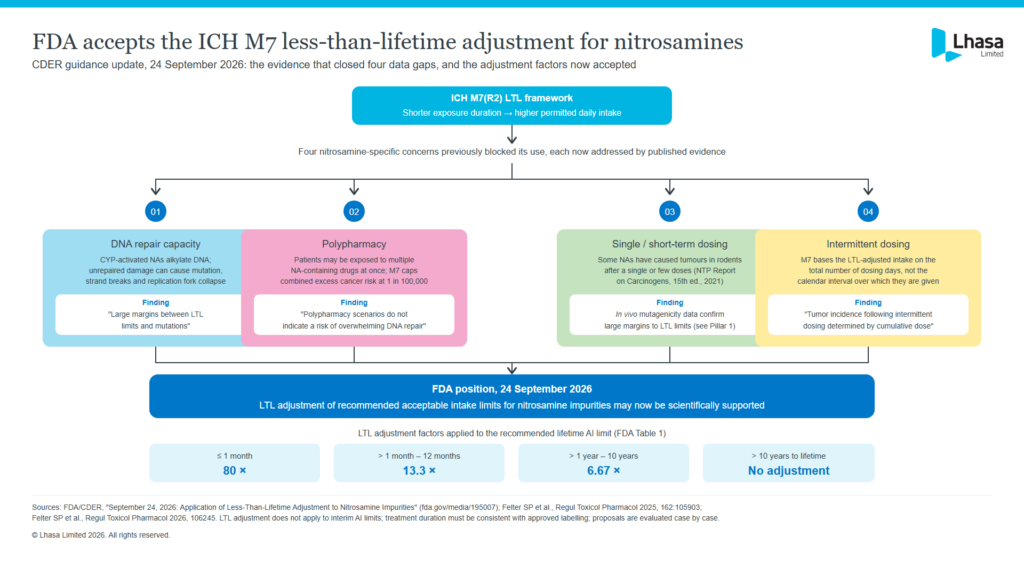
Figure: ICH M7(R2) LTL adjustment factors as applied to nitrosamine impurities, and the evidence behind the change (Lhasa Limited, 2026)
Worked example, from the guidance itself: the recommended lifetime AI limit for N-nitrosodiethylamine (NDEA) is 26.5 ng/day. For a drug administered for less than 30 days in a lifetime, the LTL-adjusted limit would be 2,120 ng/day (26.5 x 80). For a drug administered once per week for 2 years, the calculation uses total dosing days (104), which falls in the 1 to 12 month category, giving 352.5 ng/day (26.5 x 13.3).
The science behind the reversal
CDER cites two recent publications in Regulatory Toxicology and Pharmacology (Felter et al., 2025 and 2026), developed in part through the Nitrosamines Research Program of the Health and Environmental Sciences Institute (HESI). In direct response to the regulatory concerns, I and colleagues from across industry and regulatory agencies set out to test each of the hypotheses and determine whether LTL should be applicable to nitrosamines. Building on the carcinogenicity studies collated in the Lhasa Carcinogenicity Database (LCDB), we were able to address these concerns. Together, these papers provide the evidence that nitrosamine cancer risk is consistent with a cumulative dose response relationship, and that the earlier concerns about DNA repair capacity and polypharmacy do not preclude LTL adjustment when appropriate safeguards are in place.
Conditions and caveats
Please be aware that this is a targeted adjustment, not a blanket relaxation. Key conditions from the guidance update:
Treatment duration must match approved labelling. The duration used to select the adjustment factor must be consistent with the labelled indication and dosing regimen. Where labelling covers both short-term and long-term use, CDER generally intends to consider the long-term use.
Intermittent dosing uses total dosing days, related back to the duration categories, as in the NDEA example above.
Interim AI limits are excluded. LTL adjustment is not recommended for interim AI limits listed on the CDER web page.
Multiple nitrosamines are capped in total. Where a product contains more than one nitrosamine impurity, the control strategy for total exposure must not exceed the 1 in 100,000 risk estimate when LTL factors are applied.
Each proposal is evaluated case by case. Submissions should include a scientific justification for the proposed LTL-adjusted AI limit and the indicated population, with “LTL Request” in the subject line of communications with CDER.
Approved products need a supplement. A proposal for an AI limit higher than the FDA-recommended limit is generally a major change requiring a prior approval supplement.
What should you do now?
Identify candidate products. Short-course treatments (antibiotics, acute indications), intermittent or PRN dosing, and products with defined treatment durations in labelling are the obvious candidates.
Confirm the applicable lifetime AI limit for each nitrosamine impurity, from compound-specific data, read-across, or the carcinogenic potency categorisation approach (CPCA), before applying any adjustment. The adjustment factor is only as defensible as the lifetime limit underneath it.
Recalculate and document. Apply the duration category from labelling, calculate the LTL-adjusted limit, and build the scientific justification the FDA expects, including duration rationale and total-exposure considerations for multiple nitrosamines.
Plan the regulatory route. Pending applications: contact the review division or request a Type C meeting (NDAs) or submit controlled correspondence (ANDAs). Approved products: submit to the application, generally as a prior approval supplement.
How Lhasa Limited can support your assessment
Lhasa Limited works with industry and regulators on nitrosamine risk assessment, from hazard assessment through to acceptable intake decisions. Derek Nexus (Lhasa Limited) supports nitrosamine risk characterisation including the CPCA, the Lhasa Carcinogenicity Database Plus (LCDB Plus) provides TD50 carcinogenicity data to support compound-specific limits, and Acrostic (Lhasa Limited) supports decision-making for acceptable intakes for novel nitrosamines. Establishing the right lifetime AI limit is the foundation on which any LTL adjustment is built.
Explore our nitrosamine impurity risk assessment solutions, read how to calculate the safe limit for carcinogens as per ICH M7, or contact us to discuss your products.
Sources
FDA, “September 24, 2026: Application of Less-Than-Lifetime Adjustment to Nitrosamine Impurities“,
FDA CDER Nitrosamine Impurity Acceptable Intake Limits web page,
ICH M7(R2), Assessment and Control of DNA Reactive (Mutagenic) Impurities in Pharmaceuticals to Limit Potential Carcinogenic Risk (July 2023), Section 7.3
Felter SP et al., 2025, Evaluating the Lifetime Cumulative Dose as a Basis for Carcinogenic Potency of Nitrosamines, Regul Toxicol Pharmacol, 162:105903
Felter SP et al., 2026, Applicability of the ICH M7 Guidelines for Assessing Less-Than-Lifetime Exposure to Nitrosamine Impurities in Drug Products, Regul Toxicol Pharmacol, 106245
About the Author
David Ponting is Senior Principal Scientist at Lhasa Limited. As part of an extensive contribution to addressing the issues raised in the nitrosamine crisis, he is a co-author of both publications cited in the FDA guidance update, Felter et al. 2025 and 2026, developed in part through the Nitrosamines Research Program of the Health and Environmental Sciences Institute (HESI), which provided the scientific evidence supporting the application of less-than-lifetime adjustment to nitrosamine impurities.

Last Updated on September 30, 2026 by lhasalimited