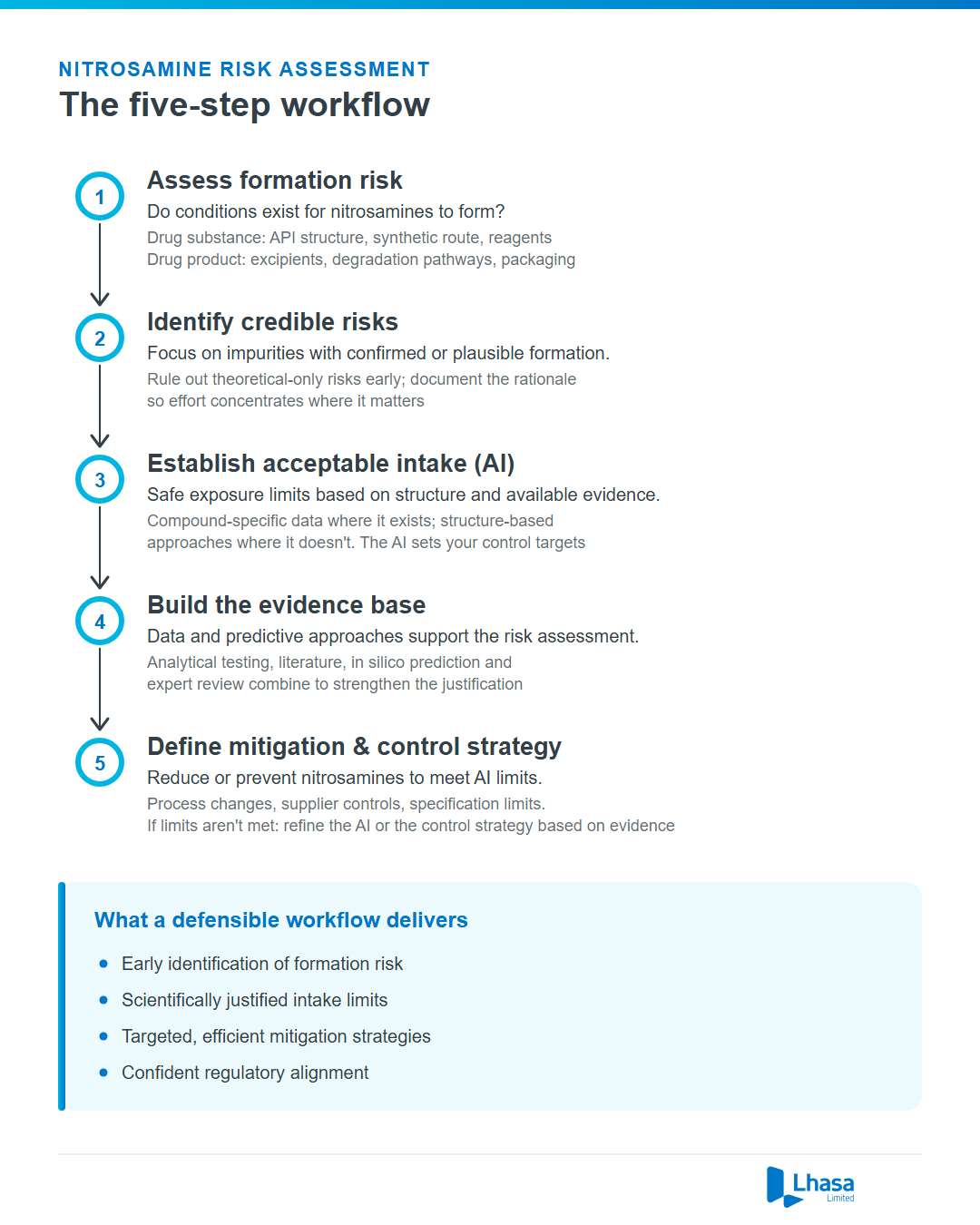
How do you assess nitrosamine impurity risk? Work through five steps: identify where nitrosamines could form, gather existing mutagenicity and carcinogenicity data, predict where data is missing, set an acceptable intake, and define a control strategy. This guide walks through each step with practical tips drawn from regulatory guidance and industry experience.
N-nitrosamines are compounds characterised by a nitroso group bonded to an amine. They sit in the ICH M7(R2) cohort of concern because many are mutagenic and potentially carcinogenic even at very low intakes, which is why regulators worldwide require a documented risk assessment for both drug substance and drug product.
Where do nitrosamines come from?
Formation risk is the starting point. Nitrosamines need two things to form: an amine (often a secondary amine) and a nitrosating agent, brought together under favourable conditions such as low pH.
- Assess the whole lifecycle. Formation can occur in the manufacturing process or during storage, so the risk assessment must cover reagents and materials, degradation, cross contamination, the manufacturing process itself, and interactions between API, excipients and packaging.
- Work backwards through the route. Retrosynthesis is a practical way to spot where amines and nitrosating agents could meet in the synthetic route.
- Do not overlook excipients and packaging. Nitrites are common nitrosating impurities in excipients, and packaging can contribute too: nitrocellulose can react with amines in printing ink during heat sealing.
- Classify your portfolio first. Prioritise products by maximum daily dose and duration of treatment so effort lands where patient exposure is highest.
The outcome of this step is a list of credible risks: impurities with confirmed or plausible formation routes. Focus the rest of the assessment there.
What data should you gather before predicting?
Existing experimental evidence comes first; prediction fills the gaps.
- Search existing mutagenicity and carcinogenicity data for each credible nitrosamine before running any prediction. Experimental data takes precedence.
- Check the quality of historical Ames data. Historical Ames studies for nitrosamines may not be reliable where they predate or deviate from current OECD 471 conditions; appropriately conducted studies show good concordance between Ames results and carcinogenicity outcomes for nitrosamines.
- Use shared data where you can. Industry data-sharing initiatives, such as the Nitrites in Excipients consortium, pool measured nitrite levels and nitrosamine data that individual companies could not generate alone.
How do you predict risk where data is missing?
Where no adequate experimental data exists, ICH M7(R2) supports in silico assessment.
- Apply two complementary (Q)SAR methodologies, one expert rule-based and one statistical, to predict the Ames test outcome, as ICH M7 requires for impurity classification. See our guide to the five ICH M7 impurity classes for how predictions feed classification.
- Expert review matters. Predictions should be reviewed by someone who can weigh structural context, especially for borderline or conflicting results.
- Read-across is accepted by regulators for nitrosamines: analogues can be selected by structural similarity and grouped by structural features, provided the justification is documented.
How do you set the acceptable intake?
- Use the carcinogenic potency categorisation approach (CPCA) as the nitrosamine-specific starting point for acceptable intake, based on the structural features around the N-nitroso group.
- Reliable carcinogenicity data takes precedence. Where a nitrosamine (or a well-justified read-across analogue) has adequate carcinogenicity data, a compound-specific limit can be derived from it.
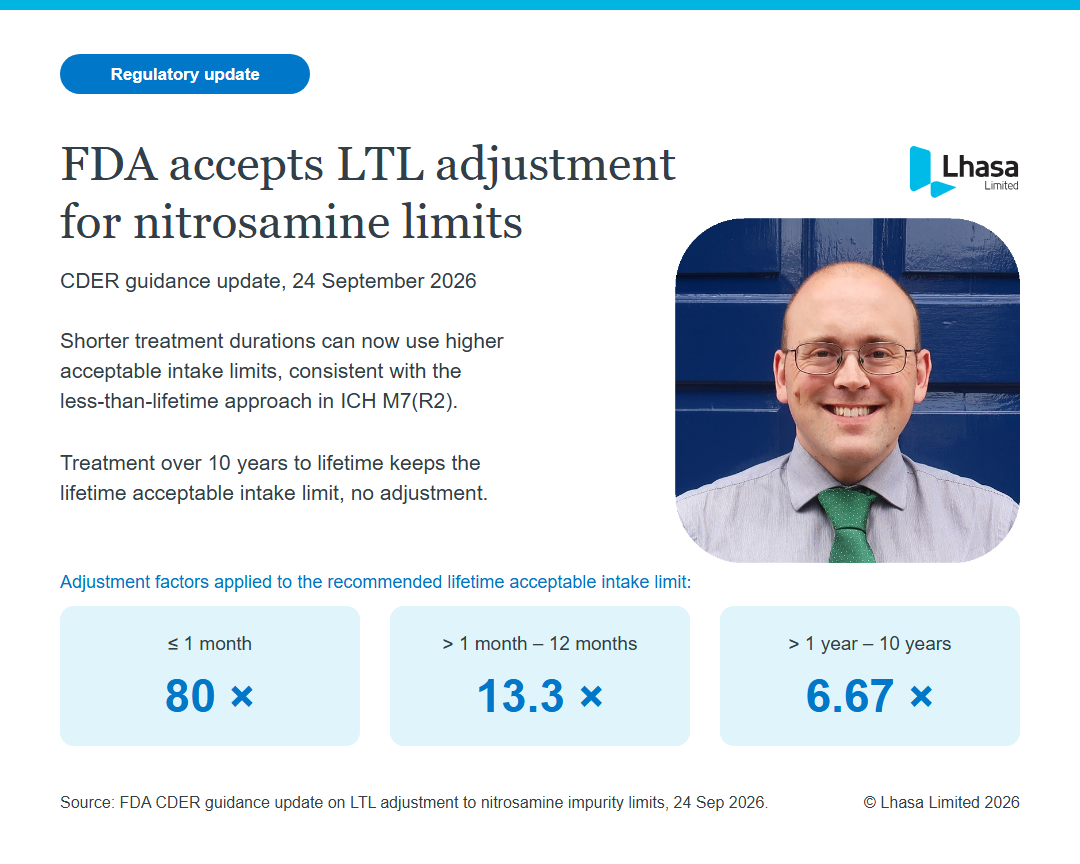
- Know when limits can be adjusted. Recognised situations include reliable compound-specific carcinogenicity data, a suitable analogue with reliable data, less-than-lifetime exposure scaling (the FDA now accepts LTL adjustment for nitrosamines, see what you need to know about the FDA LTL adjustment), and appropriately conducted negative test evidence.
How do you control and document the risk?
- Evaluate purge first. Purge factor calculation under ICH M7 control option 4 is typically the first strategy to evaluate; where a suitable purge ratio is demonstrated, analytical testing may not be needed.
- Follow the stepwise regulatory expectation: risk assessment, then confirmatory testing where the assessment indicates risk, then control of nitrosamines to the acceptable intake.
- Document to submission standard. The assessment should show complete impurity coverage, the evidence behind each decision, and a control strategy a reviewer can follow.
Where Lhasa Limited fits
Lhasa Limited tools and expertise support each step of this workflow: complementary (Q)SAR methodologies for Ames test outcome prediction, curated toxicity and carcinogenicity data, purge and degradation assessment, and read-across support for nitrosamine potency. Explore the nitrosamine impurity risk assessment solution page to see how the pieces fit together, or get in touch to talk through your assessment.
This guide builds on the practical tips first shared by Diego Gomes following the Lhasa Limited Nitrosamine Impurity Workshop, updated for current guidance including ICH M7(R2) and the CPCA.
Last Updated on October 15, 2026 by lhasalimited