
Chat with us, powered by LiveChat ICH M7 & Nitrosamine Regulatory Evidence Hub | Lhasa Limited

ICH M7 | Nitrosamines | Regulatory best practice

Resource hub

Evidence you can take to a regulator.

This hub brings together the best-practice papers, guidance and case studies that make Lhasa in silico solutions and data-sharing initiatives defensible in your regulatory submissions.

ICH M7 · Mutagenic impurities

What a defensible ICH M7 assessment looks like

ICH M7 was the first guideline to accept (Q)SAR predictions (computer models that link chemical structure to activity) in place of a lab assay. Watch the six-step overview, then use the resources linked to each step.

Video · ICH M7: 6 steps to a defensible assessment of mutagenic impurities
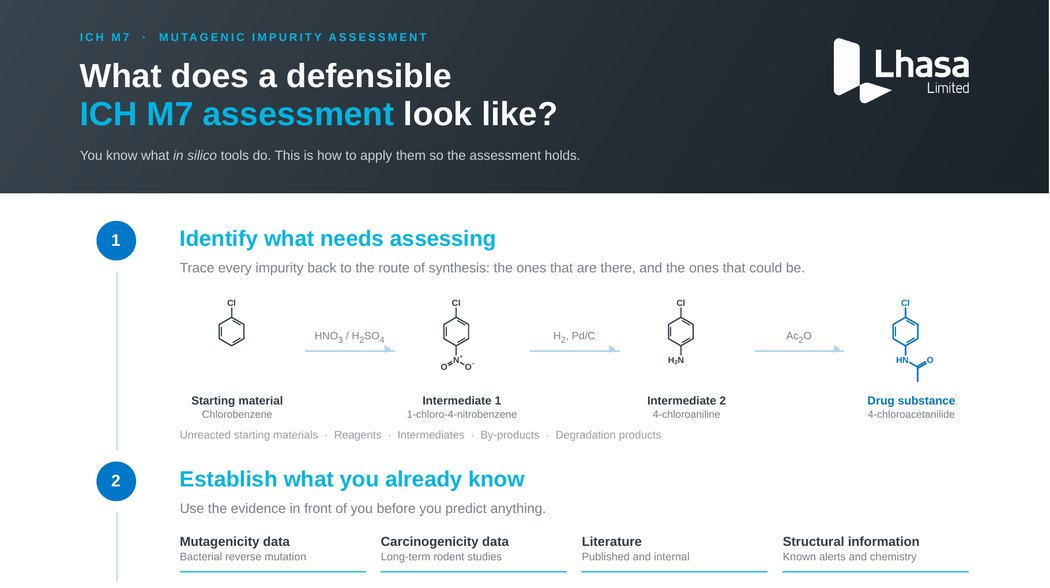
The six steps on one page

A printable guide to keep beside your assessment. Reflects ICH M7(R2).

Download the guide (PDF)
  1. Identify what needs assessing

    Trace every impurity back to the route of synthesis: the ones that are there, and the ones that could be.

  2. Establish what you already know

    Use existing mutagenicity data, carcinogenicity data, literature and structural information before you predict anything.

  3. Apply two complementary predictions, and understand why they differ

    Combine an expert rule-based and a statistical prediction, then review the evidence behind each call.

    Flagship paper

    Establishing best practice in the application of expert review of mutagenicity under ICH M7

    The framework, written with industry and regulatory scientists, for deciding when in silico predictions can stand in for the bacterial reverse mutation (Ames) test.

    Lead-authored by Chris Barber of Lhasa Limited and still cited today, the paper sets out how to review expert rule-based and statistical predictions together, with a defined decision rule for when no further experimental testing is needed. More than a decade after ICH M7 was adopted, it shows what an accepted non-animal method looks like in practice.

    • EvidenceDerek Nexus and Sarah Nexus (Lhasa Limited) combined reach accuracy comparable to the Ames test (around 85%).
    • Use it forExpert review of (Q)SAR mutagenicity predictions for impurities.
    • OutcomeA classification regulators accept under ICH M7, without further testing.
    Read the paper
  4. Reach one conclusion

    Weigh existing data, both predictions and expert review together into one ICH M7 class. For a Class 1 impurity, you then need a compound-specific acceptable intake.

    Best practice

    Selecting the most reliable carcinogenicity study to derive acceptable intakes under ICH M7

    Replace subjective literature review with an automated, validated workflow. Choose the most reliable long-term study from an expanded dataset and calculate a bespoke TD50 (the dose that causes tumours in half of test animals), with no new animal studies.

    View resource
  5. Decide what the risk means for control

    The assessment ends at what you do about it. The better your fate and purge evidence, the less analytical testing you need to justify.

    Best practice

    Purge factor calculation: solubility best practice

    Calculate and justify a solubility purge factor for ICH M7 Option 4. Show through process chemistry that an impurity stays below threshold, without additional analytical testing.

    View resource

ICH M7 · Nitrosamines

Nitrosamines: from potency categories to less-than-lifetime limits

Lhasa research underpins how regulators set acceptable intakes (AIs) for nitrosamine impurities: first through the Carcinogenic Potency Categorisation Approach (CPCA), and now for medicines taken for less than a lifetime.

5
Lhasa publications form the evidence base for the CPCA
2
Papers co-authored by Lhasa scientists support less-than-lifetime AIs (FDA, 2026)
4
Regulators cite this research: FDA, EMA, Health Canada and ANVISA

As of October 2026.

New · September 2026Cited by FDALess-than-lifetime exposure

The evidence behind less-than-lifetime limits for nitrosamines

Lifetime AIs assume a patient takes a medicine every day for 70 years. For shorter treatments, ICH M7 allows a less-than-lifetime (LTL) adjustment, but its use for nitrosamines had been questioned.

FDA draft guidance published in September 2026 cites two papers, co-authored by Lhasa scientists with industry and regulatory researchers, as sufficient evidence to address those concerns. They show that cancer risk from nitrosamines follows total cumulative dose, and that DNA repair and polypharmacy do not rule out an LTL adjustment.

Read the FDA draft guidance

More nitrosamine resources

Best practice

Read-across and surrogate selection for novel nitrosamines

No CPCA category for your nitrosamine? Use a validated method to select a read-across surrogate from existing analogue data and derive an acceptable intake, instead of commissioning a new study.

Industry best practice

Nitrite testing in excipients

Assess nitrite risk in excipients with analytical data pooled across companies through the Nitrites in Excipients data sharing initiative from Lhasa, and rule out unnecessary testing during formulation development.

Beyond ICH M7

The same approach, applied to other guidelines

The expert review and weight-of-evidence principles behind ICH M7 now support alternatives to other long-running animal studies.

ICH S1B(R1)Carcinogenicity

Industry and regulatory best practice for carcinogenicity assessment

Build an adverse outcome pathway (AOP) weight-of-evidence case to waive the two-year rat bioassay.

View resource
Skin sensitisationExpert review

Best practice for expert review of sensitisation data and predictions

A reliable process for reviewing and approving in silico sensitisation calls in place of further animal testing.

View resource
ICH Q3EExtractables and leachables
Webinar

Building defensible E&L justifications

Build an audit-ready toxicological justification without a new toxicity study for every extractable in scope.

Watch the webinar
ICH Q1A(R2)Stability and forced degradation
Whitepaper

Benchmarking in silico degradation predictions against stability data

See how predicted degradation pathways compare with accelerated and long-term stability study results, and use that evidence to focus forced degradation studies on the pathways that matter.

Read the whitepaper

Regulatory track record

From published science to regulatory guidance

Regulators cite Lhasa publications directly. We checked each citation against the published guideline or guidance document.

14
Lhasa publications, plus two solutions, cited directly in regulatory or guideline documents
7
Regulatory documents across five jurisdictions citing Lhasa publications, plus ICH guidelines and Q&As
27
Further Lhasa publications underpinning current industry best practice

Cited publications, by year published

2017
2018
2019
2020
2021
  • Cross & PontingHealth Canada Nitrosamine Guidance; ANVISA Guia 50/2021; FDA RAIL
2022
  • Chilton et al.ICH Q3E draft; EMA Reflection Paper 2026
  • Thomas et al.Health Canada Nitrosamine Guidance; ANVISA Guia 50/2021; FDA RAIL
  • Ponting et al.Health Canada Nitrosamine Guidance; ANVISA Guia 50/2021; FDA RAIL
2023
2024
2025 New
  • Felter et al.FDA draft guidance: less-than-lifetime adjustment for nitrosamines (2026)
2026 New
  • Felter et al.FDA draft guidance: less-than-lifetime adjustment for nitrosamines (2026)

Counts shown as of October 2026. Year shown is the year of publication. Each entry lists the regulatory documents that cite it. Author names link to the publication.

Bring this evidence into your next submission

Talk to our scientists about applying these methods in your workflow, and how to present the evidence to regulators.