
Chat with us, powered by LiveChat UK Government Strategy For Replacing Animals In Science Whitepaper | Lhasa

Translating ambition into reality: implementing the UK Government strategy for replacing animals in science

A collaborative, industry-led whitepaper exploring how the UK Government strategy for replacing animals in science can move from ambition to practical implementation.

Informed by a cross-sector roundtable convened by Lhasa that included representatives from organisations including AstraZeneca, Cruelty Free International, GlaxoSmithKline, Kirkland Consulting, Labcorp, Liverpool John Moores University, NC3Rs, Syngenta and Unilever, the paper examines key priorities for accelerating the adoption of non-animal new approach methodologies (NAMs) across safety assessment and regulatory science.

Drawing on insights from a cross-sector roundtable convened by Lhasa, it highlights practical actions to support regulatory acceptance of NAMs, strengthen Context of Use frameworks, advance validation and qualification, improve data infrastructure and promote international alignment.

For organisations working with NAMs, animal replacement, regulatory toxicology and the UK strategy for replacing animals in science, the whitepaper provides a practical perspective on turning policy ambitions into real-world implementation.

UK Government Strategy for Replacing Animals in Science Whitepaper | Lhasa

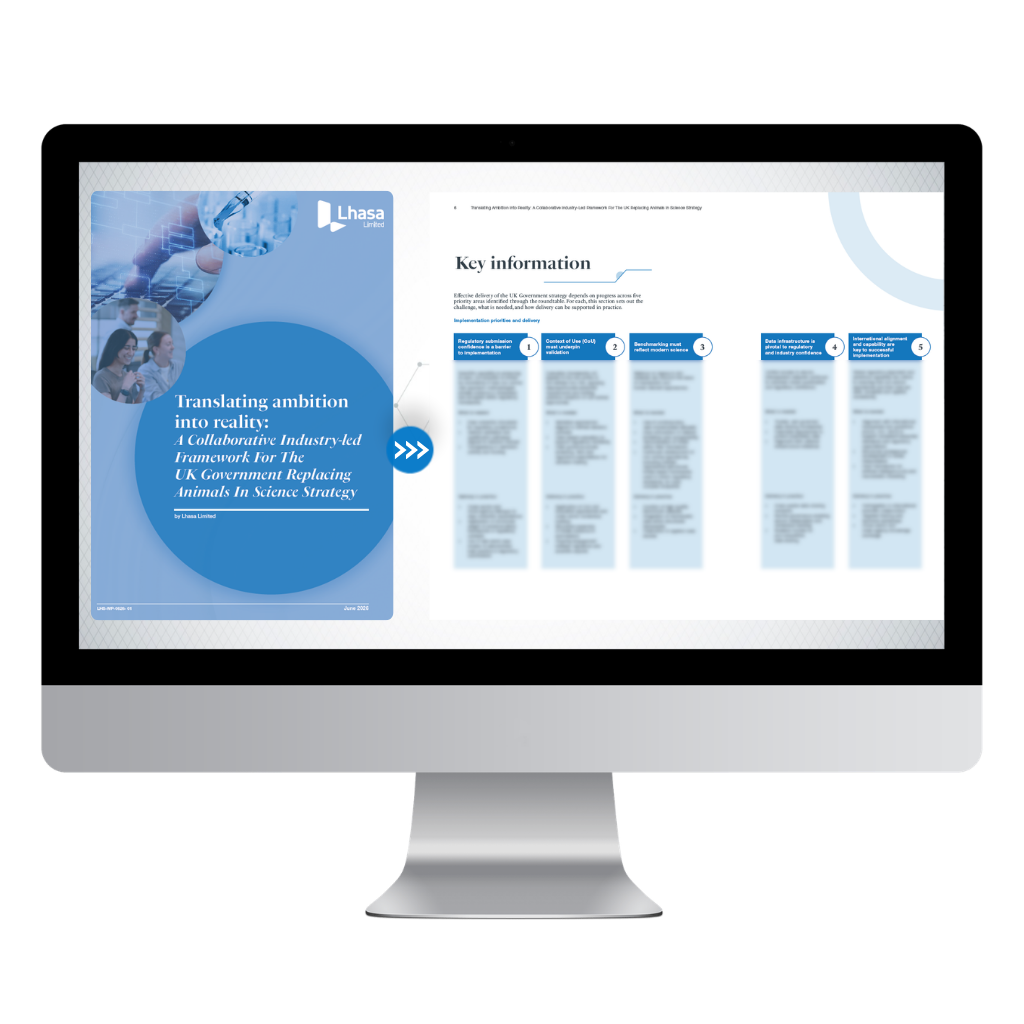
Access the whitepaper: Translating ambition into reality: A Collaborative Industry-led Framework For The UK Government Replacing Animals In Science Strategy

EU Policy Update

The European Commission has published its Roadmap Towards Phasing Out Animal Testing For Chemical Safety Assessments, reinforcing the growing international focus on accelerating the adoption of non-animal approaches.

While this whitepaper focuses on the UK Government Strategy for Replacing Animals in Science, many of the implementation priorities are shared across the UK and Europe, including regulatory confidence, validation, Context of Use, data infrastructure and scientific capability.

Download the whitepaper to explore the practical actions needed to support wider adoption of non-animal approaches in safety assessment and regulatory science.

Be part of the wider conversation

The whitepaper, ‘Translating ambition into reality: A Collaborative Industry-led Framework For The UK Government Replacing Animals In Science Strategy’ is part of the ongoing work Lhasa does to support the practical, evidence-led adoption of non-animal approaches.

This conversation is only the beginning.

Progress will depend on continued collaboration between those developing, applying, evaluating and enabling these approaches across science, industry, regulation and policy.

If you would like to be part of future discussions, share your perspective, or stay informed about developments in this area, we invite you to join our mailing list.

We would welcome continued discussion with those working across industry, academia, regulation, policy and the wider scientific community.

As an independent, not-for-profit organisation, Lhasa helps bring together diverse voices, scientific expertise and collaborative networks to support evidence-led progress on shared scientific challenges.

Join our mailing list to receive updates on this topic, hear about future discussions and events, and register your interest in contributing to future activity.

Share this resource:

Perspectives on advancing the UK Government strategy for replacing animals in science

This Lhasa whitepaper brings together insights from contributors across industry, academia, NGOs and research funders. The perspectives below reflect the collaborative discussions that informed the paper and highlight key considerations for supporting the wider adoption of NAMs in line with the UK strategy for replacing animals in science.

Frequently asked questions

What is the whitepaper about?

This whitepaper, Translating ambition into reality: A Collaborative Industry-led Framework For The UK Government Replacing Animals In Science Strategy, examines how the UK Government’s Strategy to Accelerate the Uptake of Non-Animal Methods, Technologies and Approaches can be translated into practical action. It focuses on the adoption of non-animal new approach methodologies (NAMs), and explores key enablers such as regulatory confidence, Context of Use, validation, data infrastructure, international alignment and scientific collaboration.

Who contributed to the whitepaper?

Translating ambition into reality: A Collaborative Industry-led Framework For The UK Government Replacing Animals In Science Strategy was informed by a cross-sector roundtable convened by Lhasa, bringing together experts from industry, academia, NGOs and research funders.

Contributors from organisations including AstraZeneca, Cruelty Free International, GlaxoSmithKline, Kirkland Consulting, Labcorp, Liverpool John Moores University, NC3Rs, Syngenta and Unilever, shared perspectives on accelerating the uptake of NAMs in safety assessment and regulatory science.


Who is the whitepaper for?

The whitepaper Translating Ambition into Reality is for professionals working across industry, government, regulatory bodies, policy, academia and the wider scientific community who are involved in the development, application or regulation of non-animal approaches across science.

This includes those working in toxicology, safety assessment, regulatory science, biomedical research, environmental science, chemical safety, consumer product safety, advanced modelling, New Approach Methodologies, data sharing, in silico methods and scientific innovation.

You can view the whitepaper, by clicking here.

How does the EU roadmap relate to this whitepaper?

The European Commission published its Roadmap Towards Phasing Out Animal Testing for Chemical Safety Assessments on 1 June 2026. The roadmap reinforces the growing international focus on accelerating the adoption of non-animal approaches while maintaining protection for human health and the environment.

While this whitepaper focuses on the UK Government strategy for Replacing Animals in Science, many of the practical implementation priorities are shared across the UK and Europe. These include regulatory confidence, Context of Use, validation and qualification, trusted data infrastructure, scientific capability and international alignment.

By setting out these priorities through an industry-led UK lens, the whitepaper contributes to a wider conversation about how non-animal New Approach Methodologies (NAMs) can be adopted confidently across safety assessment and regulatory science.

Why is replacing animals in science important?

Replacing animals in science can help improve human-relevant safety assessment, support scientific innovation, reduce reliance on animal testing and enable more efficient decision-making.

The UK Government’s strategy for replacing animals in science sets out an ambition to support the wider use of non-animal approaches in scientific research and safety assessment. As interest in these approaches continues to grow, attention is increasingly focused on the practical steps needed to support their adoption across research, regulation and industry.

What are non-animal new approach methodologies (NAMs)?

Non-animal new approach methodologies (NAMs) include in vitro methods, in silico models, computational toxicology, read-across approaches, artificial intelligence-enabled tools, and other technologies that can support safety assessment without the use of animal testing.

How can I be involved?

You can sign up to receive updates on non-animal New Approach Methodologies (NAMs) events, discussions and activities related to replacing animals in science. You can also be informed about upcoming discussions, workshops and opportunities, including new whitepapers to contribute to ongoing conversations.

You can sign up, by clicking here.