Nitrosamine qualification remains one of the most complex and fast-moving areas in pharmaceutical safety assessment. As scientific understanding advances and regulatory expectations continue to evolve, organisations are increasingly looking beyond one-size-fits-all approaches to support confident, scientifically justified decisions.
In our recent webinar, Science-led approaches to nitrosamine qualification and safety assessment, Dr Joel Bercu and Dr Ben Thornton explored how approaches including the carcinogenic potency categorisation approach (CPCA), enhanced testing strategies, read-across, and curated data sources are helping organisations navigate this challenging landscape.
Here are some of the key insights from the session.
Navigating a shifting regulatory landscape
One of the clearest themes throughout the webinar was the continued evolution of global nitrosamine guidance. Regulatory authorities including the US Food and Drug Administration (FDA), European Medicines Agency (EMA), Health Canada (HC), Swissmedic, ANVISA, and Therapeutic Goods Administration (TGA) continue to refine their approaches as new scientific evidence emerges.
While many core principles are aligned, regional differences still present challenges for organisations developing global qualification strategies. Audience polling reflected this clearly, with attendees identifying the interpretation of evolving regulatory guidance as one of their biggest current challenges.
The speakers also highlighted the anticipated nitrosamine addendum to International Council for Harmonisation of Technical Requirements for Pharmaceuticals for Human Use M7, which is expected to further harmonise scientific and regulatory expectations internationally.
Collaborative research is helping close scientific gaps
A major focus of the webinar was the ongoing work of the Health and Environmental Sciences Institute (HESI) Nitrosamine Research Program.
Established in 2022, the collaborative initiative brings together industry, regulators, academia, consultants, and non-governmental organisations to address key scientific questions surrounding nitrosamine risk assessment. Joel outlined several active research areas, including Ames assay optimisation, in vitro testing strategies, in vivo follow-up studies and (Q)SAR and quantum mechanics (QM)-based approaches. The programme aims to generate robust scientific evidence that can inform future regulatory guidance and support more confident nitrosamine qualification strategies.
The scale of collaboration behind the initiative also reflects a broader shift within the industry toward integrated, mechanism-driven assessment approaches supported by high-quality experimental data.
Enhanced Ames testing strengthens confidence in hazard identification
The webinar explored recent progress in enhanced Ames assay strategies for nitrosamine assessment. Because nitrosamines require metabolic activation, questions have historically existed around whether standard Ames conditions are sufficiently sensitive for certain nitrosamine-related mutagenic effects.
Joel discussed collaborative ring trials investigating enhanced Ames conditions using increased concentrations of rat and hamster S9 metabolic activation systems. The studies demonstrated:
- High sensitivity for nitrosamine detection
- Strong inter-laboratory reproducibility
- Good correlation with in vivo transgenic rodent mutation assay data for NDSRIs
Together, these findings continue to strengthen confidence in enhanced Ames assays as a practical and scientifically robust approach for nitrosamine hazard identification.
The discussion also reinforced the central role of metabolism in nitrosamine activation, highlighting why assay design and metabolic competency remain critical considerations when developing testing strategies.
Moving beyond CPCA alone
Dr Ben Thornton explored how computational toxicology and in silico approaches have evolved since the introduction of the carcinogenic potency categorisation approach (CPCA) framework. While CPCA remains an important foundation for nitrosamine qualification, the webinar highlighted how organisations are increasingly integrating additional lines of evidence to support more refined and scientifically defensible assessments. These include curated carcinogenicity data, read-across, benchmark dose modelling, mechanistic understanding, (Q)SAR modelling, and expert review.
Read-across formed a major part of the discussion, particularly for more complex nitrosamines and NDSRIs. Ben demonstrated how structurally relevant surrogate compounds, combined with robust carcinogenicity data, can help derive more representative acceptable intakes for certain nitrosamines.
However, both speakers emphasised that successful read-across depends on far more than structural similarity alone. Toxicological relevance, data quality, mechanistic plausibility, and confidence in the analogue relationship all remain critical considerations.
Several tools and resources were also discussed throughout the session, including Derek Nexus and Sarah Nexus for supporting ICH M7 (Q)SAR expectations, Acrostic for supporting read-across workflows and acceptable intake derivation, and LCDB Plus and Vitic as curated carcinogenicity databases.
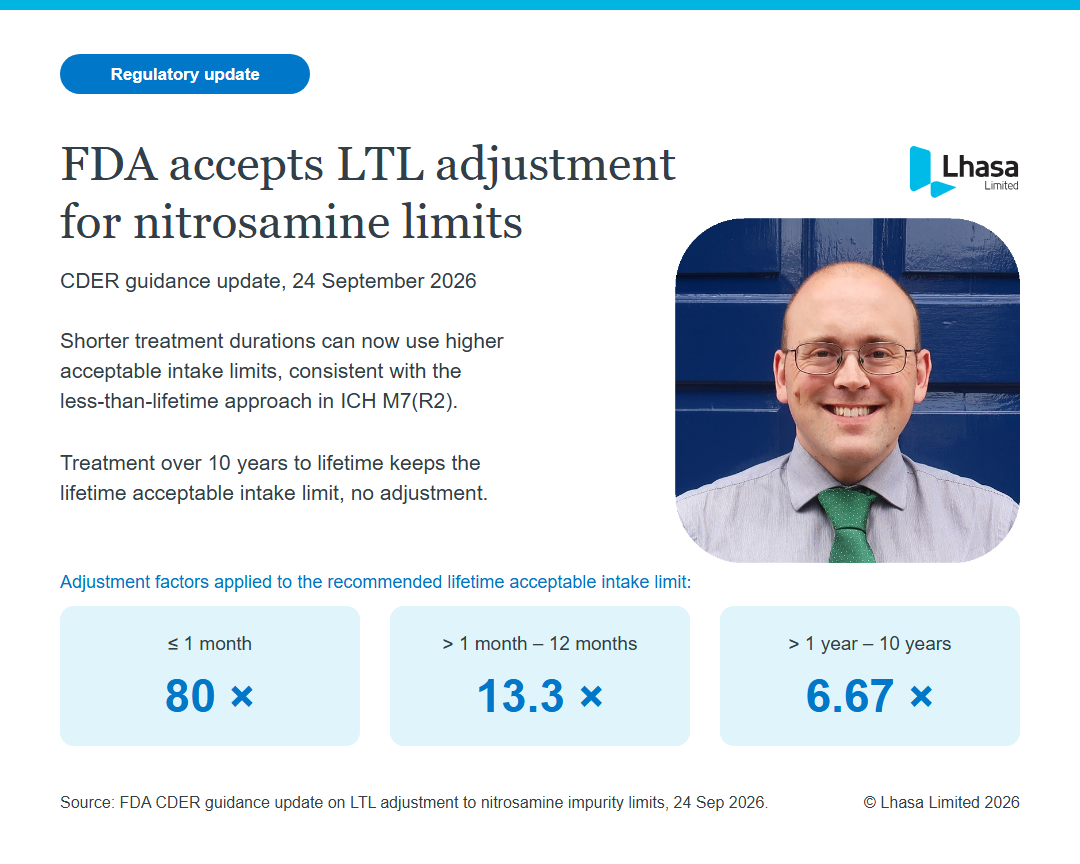
The webinar also explored ongoing discussions around less-than-lifetime (LTL) exposure approaches for nitrosamines. Emerging research continues to support the scientific rationale for LTL concepts, although regional regulatory implementation still varies.
What comes next for nitrosamine qualification?
A key message throughout the webinar was that nitrosamine qualification increasingly relies on integrated, science-led approaches that combine predictive modelling, curated data, mechanistic understanding, and expert review to support robust decision-making.
As nitrosamine science continues to evolve, organisations are adopting increasingly integrated qualification strategies to support more robust and transparent safety assessments.
At Lhasa Limited and Consult Lhasa, we continue to support the life sciences sector through scientific expertise, curated data resources, and computational toxicology solutions including Derek Nexus, Sarah Nexus, Vitic, LCDB Plus, and Acrostic.
Thank you again to Joel and Ben for sharing their expertise, and to everyone who joined the webinar and contributed to the discussion.
If you would like to catch up on the webinar recording or explore how Lhasa can support your nitrosamine qualification, please get in touch.
Request more informationLast Updated on May 26, 2026 by lhasalimited