At Lhasa, we believe that the future of science is built on collaboration and the brilliance of the next generation. We are delighted to announce that the 2025 Lhasa Young UK Scientist Award was presented at this year’s Industrial Genotoxicology Group (IGG) Annual Meeting, an event which brings together experts to explore the evolving role of biological relevance in toxicology and regulatory science.
The award recognises early-career scientists who are making valuable contributions to the field of genotoxicology and provides an opportunity to share their research with experts from across industry and academia.
Recognising early-career scientists in genotoxicology
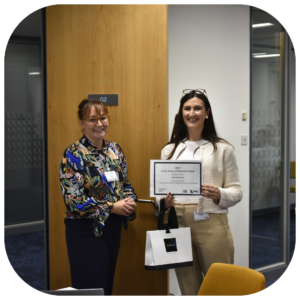
This year’s winner, Abbie Williams, a Senior Scientist at GSK, stood out for her critical work in nitrosamine mutagenicity assessment. Abbie’s research is helping strengthen mutagenicity assessment approaches within the pharmaceutical industry, and we sat down with her to discuss her work, the regulatory challenges it helps address, and what winning the award means to her.
What research did you present, and what problem does it aim to solve?
Within the pharmaceutical industry, the nitrosamine impurity space is constantly evolving. As part of this, in vitro mammalian cell mutation assays are used within a battery of tests to support acceptable intake limits within active pharmaceuticals.
The research that I presented at the 2025 IGG meeting involved developing an in‑house OECD‑compliant HPRT assay protocol to establish its application domain within the pharmaceutical industry and support robust nitrosamine mutagenicity assessments.
Why did you choose to focus on this area of research?
I didn’t have any prior experience with the HPRT assay, so the opportunity to learn it and build new expertise was really interesting.
At the same time, the current focus on nitrosamines within the pharmaceutical industry has made mutagenicity assessment more important than ever. I feel that we are duty‑bound to conduct robust, high‑quality mutagenicity assessments, not just to meet regulatory expectations, but to protect patients and enable safe access to essential medicines.
You began your career through an apprenticeship. How has that journey developed?
Post A‑Levels, I enrolled in the GSK apprenticeship scheme within the Genetic Toxicology department. The scheme allowed me to learn core skills and assays whilst studying for an undergraduate degree in Bioscience.
Since completion, I have also undertaken a part‑time Masters Research degree with Swansea University, which this research contributed towards. I have now been at GSK for nearly nine years! In this time, I have gained expertise in a range of genetic toxicology assays as well as the wider pharmaceutical space.
What are the benefits of winning the Lhasa Young Scientist Award?
Winning the Lhasa Young Scientist Award was an invaluable experience. Presenting the work I have been completing as part of my Masters project felt like a milestone, both personally and professionally, and marked the culmination of this research.
I would encourage all early‑career scientists to get involved with this award because it is a great development opportunity and a fantastic platform to present your work to an audience of experts in the field. It also provides the chance to network, gain new ideas, and benefit from funding to attend a conference of your choice.
What advice would you give to aspiring scientists at the start of their careers?
I would say that it’s important to be passionate about the area of research that you are in, or the day‑to‑day role that you have.
I also think that it’s important to take advantage of every opportunity you are offered as a new scientist, training in a new area, chances to network, or presenting your work externally. It’s the perfect time to build skillsets and step outside of your comfort zone.
Abbie’s dedication to advancing the field of genetic toxicology and her commitment to high‑quality, patient‑focused research are clear throughout her work. Her recognition as the 2025 Lhasa Young Scientist Award winner reflects both her scientific expertise and her drive to make a meaningful impact in the pharmaceutical industry.
We are proud to support the scientists of tomorrow. Want to stay at the forefront of genotoxicology and industry‑shaping research? Follow our upcoming events to discover the research shaping the industry.
Last Updated on March 18, 2026 by lhasalimited