






In silico mutagenicity assessment
Streamlining the computational assessment and
control of mutagenic impurities
In silico methods are routinely used to assess the mutagenic potential of chemicals across a range of regulatory frameworks. In pharmaceuticals, the ICH M7 guideline provides a practical framework for the identification, categorisation, qualification and control of potentially mutagenic impurities to limit carcinogenic risk, requiring the use of two complementary (qualitative) (Q)SAR methodologies, one expert rule-based and one statistical-based. Beyond pharmaceuticals, regulatory expectations are also evolving in other sectors; for example, the OECD Draft Revised Guidance on the Definition of Residue supports a systematic approach to identifying and assessing residues and their metabolites for dietary risk assessment and regulatory decision-making. In this context, (Q)SAR methodologies play an increasingly important role in supporting the identification and assessment of mutagenic hazards, and can be used as a substitute for experimental assays such as the bacterial reverse mutation (Ames) test where appropriate.
Our solution
To support confident mutagenicity assessment across regulatory contexts, including ICH M7 classification of impurities in a synthetic route, we recommend combining Derek Nexus, Sarah Nexus, Vitic and the Lhasa Carcinogenicity Database Plus (LCDB Plus).
Click on the different software logos to learn more.
A flexible approach, tailored to your needs
This guided workflow illustrates one recommended approach to mutagenicity assessment. Each Lhasa solution can also be used independently, or combined as needed, depending on your scientific questions, regulatory context and existing data.
Predict mutagenic potential using complementary (Q)SAR methodologies
Perform an in silico mutagenicity assessment using complementary (Q)SAR methodologies Derek Nexus and Sarah Nexus, as recommended by ICH M7 and OECD.
Structural alerts, probability scores, and expert review arguments from both models give reviewers a transparent starting point for expert assessment.
Check existing data before generating new data
Search Vitic for existing mutagenicity data on the query compound or its structural analogues, reducing reliance on prediction alone where real data already exists.
Review long-term carcinogenicity study data in LCDB Plus to establish whether the compound is already a known carcinogen, which directly affects its ICH M7 classification. Where carcinogenicity data exists without a readily available potency value, calculate a TD50 to support dose-based risk assessment.
Integrate evidence to reach a defensible classification
Combine (Q)SAR predictions, existing experimental data, and expert scientific judgement to determine an impurity's ICH M7 classification. Documented reasoning at each stage supports traceable, well-evidenced submissions aligned with regulatory expectations, such as ICH M7.
Derek Nexus is an expert-knowledge based software, which can help you to meet regulatory guidance such as ICH M7 by providing fast and accurate toxicity predictions.
Derek Nexus highlights
Prioritise compounds with confidence
Early identification of a compound’s mutagenic liability helps teams prioritise which structures to progress, before committing time and resources to experimental testing. For bacterial in vitro mutagenicity specifically, Derek Nexus gives an interpretable basis for judging the reliability of a negative prediction, supporting the expert review step required when assessing impurities under ICH M7.
A defensible basis for trusting a negative prediction
An absence of alerts isn’t enough on its own to waive testing under ICH M7, reviewers need to justify the lack of predicted mutagenic activity for a compound. Derek Nexus has demonstrated high negative predictivity for mutagenicity and has supporting functionality to notify when there is increased uncertainty that requires review. Sarah Nexus presents the most similar supporting structures in the training set for each prediction, enabling structural read-across from chemicals with known Ames data.
Part of a complete ICH M7 classification workflow
Built on more than 40 years of curated Structure-Activity Relationship (SAR) knowledge, Derek Nexus draws from public and proprietary data sources and works alongside Sarah Nexus and Vitic to support ICH M7 classification of an Active Pharmaceutical Ingredient’s impurities. Derek and Sarah Nexus provide the two required independent (Q)SAR methodologies, while Vitic supplies the structure-searchable data underpinning both. This gives a single, coherent classification workflow across a full impurity profile, rather than reconciling outputs from separate tools by hand.
Sarah Nexus is a statistical-based software which can help you to meet ICH M7 by identifying potentially toxic chemicals through the prediction of mutagenicity.
Sarah Nexus highlights
A statistically independent methodology for ICH M7
Sarah Nexus uses a self-organising hypothesis network (SOHN) methodology to predict the bacterial mutagenicity of a query compound, built on a fundamentally different approach to expert rule-based reasoning in Derek Nexus. Used together, Derek and Sarah Nexus satisfy the two-methodology requirement in ICH M7, so reviewers aren’t left justifying why a single model is sufficient.
Validated against the OECD (Q)SAR framework
Sarah Nexus models are built and validated in line with OECD (Q)SAR validation principles, with a defined applicability domain and documented model performance. This means the statistical basis for a prediction has already been assessed against an accepted framework, reducing the work a reviewer needs to do to defend the methodology itself in a submission.
Transparent down to strain-level predictions and references
Rather than a single pass/fail output, Sarah Nexus provides a probability score alongside predictions, with the option to interrogate results at the level of individual Ames test strains. For equivocal or complex compounds, this level of detail supports a weight-of-evidence assessment rather than a binary call taken at face value.
Strengthened by data shared across the Lhasa community
The Sarah Nexus training set combines published data with Ames mutagenicity data donated by Lhasa members, producing hundreds of structural hypotheses covering a broad area of chemical space. This collaborative data model means the applicability domain extends beyond what public data alone could support, so fewer query compounds fall outside the space Sarah Nexus can meaningfully assess.
Vitic is a structure-searchable toxicity database and data management system. When used alongside Derek Nexus and Sarah Nexus, Vitic can help you to retrieve existing data available for your compound.
Vitic highlights
Access expertly curated and peer reviewed mutagenicity and carcinogenicity data
Our regularly updated toxicity database offers high-quality, Lhasa-curated data. To maintain accuracy between Vitic data and the original data source, data is extracted manually by our scientists and peer reviewed by a second member of the science team.
A fast and efficient searching experience
Rapidly find relevant supporting examples for your impurities by structure, substructure or similarity searching, thereby adding weight to expert review.
Collaborate with industry experts through data sharing
Lhasa-hosted data sharing initiatives, including the aromatic amines, excipients, intermediates and complex nitrosamines consortia, allow anonymous sharing of mutagenicity data. These consortia avoid the need for duplicate testing and allow members to exchange knowledge with other industry experts through recurrent consortium meetings.
LCDB Plus is a structure-searchable carcinogenicity database that helps you efficiently identify, interpret and apply carcinogenicity evidence within your ICH M7 workflow. Quickly confirm both positive and negative carcinogenicity findings to support confident regulatory classifications.
LCDB Plus highlights
Confidently determine the appropriate ICH M7 classification using trusted carcinogenicity evidence
Reduce the time required to search, interpret and apply carcinogenicity data during impurity assessments. LCDB Plus helps confirm both positive and negative carcinogenicity findings, supporting confident Class 1, 3 or 5 classifications where appropriate, alongside compound-specific acceptable intake calculations using reliable TD₅₀ values.
Simplify regulatory compliance and scientific justification
Streamline regulatory submissions with transparent, reproducible carcinogenicity data. LCDB Plus combines standardised TD₅₀ methodology, advanced reliability scoring and comprehensive reporting to help support robust scientific justifications and reduce time spent responding to regulatory questions.
Access an expanded carcinogenicity dataset for efficient expert review
LCDB Plus data is manually extracted from the source and peer-reviewed by our in-house team of scientists to maintain accuracy and quality. Defining compound-specific acceptable intake (AI) limits using a standardised database simplifies the expert review process for Class 1 impurities.
Regulatory support
Aligned with internationally recognised regulatory frameworks for mutagenicity assessment.
ICH M7
Assessment and control of DNA reactive (mutagenic) impurities in pharmaceuticals to limit potential carcinogenic risk
ISO 10993
Guideline for evaluating carcinogenicity of medical devices, materials and/or their extracts
ANVISA RDC No.1006/2025
Brazilian regulation that introduces additional toxicological data requirements for approval of equivalent technical pesticide products (agrochemicals)
OECD Draft Revised Guidance on the Definition of Residue
Framework designed to harmonize how pesticide residue definitions are established globally
OECD Test Guideline (TG) 471
The definitive guidance for the Ames test, our solutions are built on Ames data which aligns to OECD 471 where possible
Related publications
Paper
- Sep 2026
- Genotoxic impurity evaluation, In silico mutagenicity assessment, Nitrosamine impurity risk assessment
Paper
- Jun 2026
- Data sharing, In silico mutagenicity assessment, NAMs Strategy
Infographic
- Apr 2026
- Genotoxic impurity evaluation, In silico mutagenicity assessment, Non-genotoxic impurity assessment
Related publications
Paper
- Sep 2026
- Genotoxic impurity evaluation, In silico mutagenicity assessment, Nitrosamine impurity risk assessment
Paper
- Jun 2026
- Data sharing, In silico mutagenicity assessment, NAMs Strategy
Infographic
- Apr 2026
- Genotoxic impurity evaluation, In silico mutagenicity assessment, Non-genotoxic impurity assessment
Recent blogs
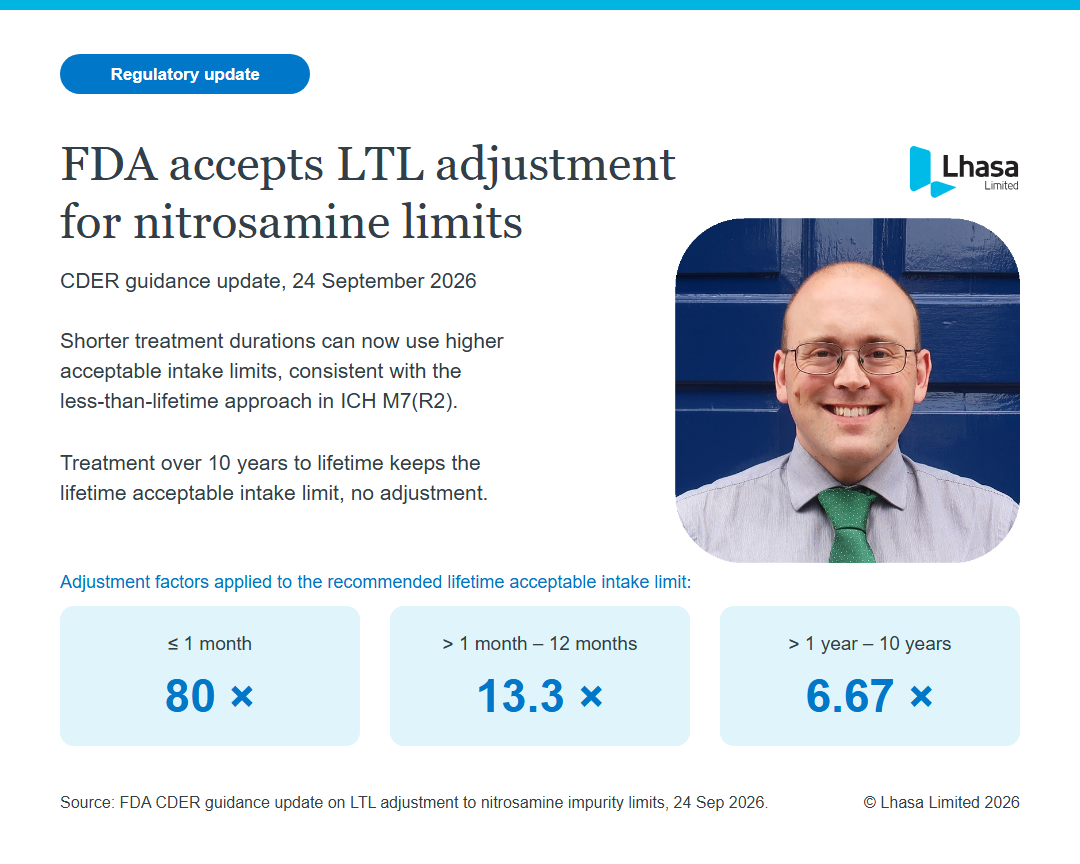
by David Ponting, Senior Principal Scientist, Lhasa Limited On 24 September 2026, the US Food and Drug Administration (FDA) published a guidance …
Forced degradation study design that is both defensible and efficient requires insight into the specific reactivity of an API before work begins …

As governments and regulators across the UK, EU and beyond move to reduce reliance on animal testing, the need for reliable and …